

Affordable SEO for small business is a monthly amount you can keep paying for months, spent only on work that brings local calls: a complete Google Business Profile, a fast website, consistent listings and a few pages built around what customers type. A tight budget buys those basics done well.
The word “affordable” stretches a long way. Our local plan starts at $159 a month. A full program with link building and AI search reporting runs about $1,500. Below, we cover each level, where to spend first, cheap-package red flags, a 30-day DIY checklist and a San Diego plumber example.
What Affordable SEO for Small Business Really Means in 2026
Affordable SEO means paying for the few tasks that move your organic visibility, at a price you can hold steady, with a partner who shows you exactly what got done each month. Good SEO services are priced by the work inside them. The monthly number matters less than what’s behind it.
Why price alone is the wrong measure
Price tells you what you’ll pay, not what you’ll get. Two agencies can charge the same low fee and deliver opposite results. One fixes your Google Business Profile and rewrites your main service page. The other sends a digital report bragging about hundreds of directory submissions.
Before you compare digital marketing companies on pricing, compare them on three things: who does the work, what you own if you leave (profile, content, analytics accounts) and whether they explain organic search results in plain words. A cheap agency that keeps your listing under its own login isn’t cheap once you try to switch.
Think of it as hiring a partner, not buying a product. The right digital partner for a one-chair barbershop in Escondido looks very different from the right one for a dental group with offices across the county. Good SEO services are built around that difference.
What a small business should spend on SEO, in plain terms
Spend on SEO only what you can keep paying for several months, because organic search results build slowly. Affordable SEO for small business starts under $200 a month; a full program with link building and AI search reporting runs about $1,500. Start with local basics, then raise the budget as calls and traffic grow.
The lists of affordable SEO companies that rank for this search only included firms with an entry price under about $2,000 a month. That sits well above what a one-truck business can spend. With a few hundred dollars, aim it at local visibility first and skip the extras.
What the price figures here cover
Every figure here is a monthly retainer for ongoing SEO services, as quoted in October 2026. None include ad spend, a website rebuild or hourly consulting, which suits a one-off audit or a single question. A retainer suits steady work. They also leave out your time for reviews and job photos, and they cover packages, not one-off projects.
Agency pricing changes, and many firms quote a custom price only after a call. When you get a quote, ask for the line items: which tasks, how often and what the report shows. If a firm can’t break its pricing down, you can’t tell what you’re paying for.
What Each Budget Level Can Buy
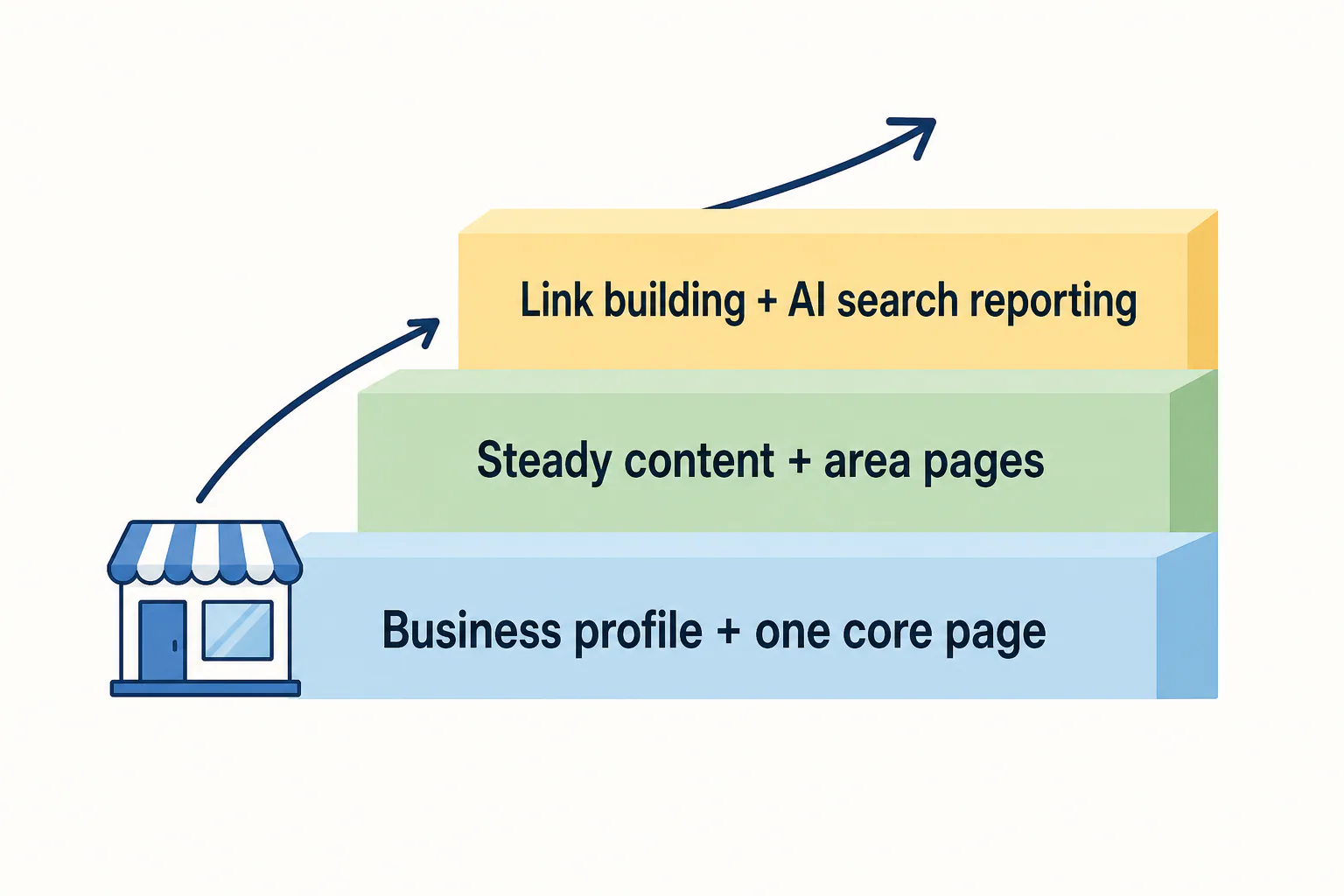
Affordable SEO for small business buys a bigger slice of the same strategy at each budget level. It starts with your map listing and one strong page, then adds content and area pages, and finally outreach and AI search reporting. The table compares the three levels.
| Level | What it buys | What it leaves out | Best for |
|---|---|---|---|
| Lower | Business profile setup and upkeep, local directory listings, one core service page | Regular content, outreach for mentions | One-location service businesses working one part of the county |
| Mid | Everything above, plus a steady blog and a page for each service area | Outreach for mentions, AI search reporting | Businesses serving several cities or selling several services |
| Higher | Everything above, plus link building and AI search reporting | Very little; this is a full program | Competitive trades and multi-location small businesses |
Lower budgets: focus on your Google Business Profile and one core page
At the lower level, nearly every dollar goes into your map listing and one core page. That’s where local customers look: 70% of local searches happen on Google Maps. A plan like ours at $159 a month covers your Google Business listing, local directories and white-hat SEO, a simple strategy for a small budget.
You won’t get a stream of new content or outreach here. That’s fine. A complete profile with real photos, accurate hours, the right categories and steady reviews is the base every other search strategy sits on. Make it your first strategy.
Mid budgets: add steady content and local pages
The mid level adds scheduled content and a page for each area you serve, which is local optimization at work. Say you clean houses in Carlsbad, Oceanside and Vista. Each town gets its own page with real details: neighborhoods, kinds of homes, a job you did there. Copy-pasted pages with only the city swapped don’t help.
Content at this level also means answering the questions customers ask on the phone, written up as posts that point back to your service pages. This is where a custom content strategy starts paying for itself, because each post targets something a nearby customer actually searches for.
Higher budgets: add link building and AI search reporting
The higher level adds link building and tracking of how you show up in AI answers. Pages that rank for this search describe that as a full program for about $1,500 a month. Link building means earning mentions from other sites, like a neighborhood news story, a supplier’s dealer page or a Little League sponsorship.
AI search reporting checks whether generative tools like AI Overviews and ChatGPT name your business when someone asks for a recommendation. It’s one of the SEO services worth adding later, once the basics are done. Paying for it while your profile is half empty is buying the roof before the foundation.
A quick rule for choosing your level
Pick your level by where your business stands today, not by what a sales rep suggests:
- Choose the lower level if you work from one location, serve one part of the county and your business profile is incomplete or unclaimed.
- The mid level fits if your profile is already solid, you serve several cities or sell several services, and calls have leveled off.
- Go higher if you compete with big regional companies for the same searches and your basics are done.
Not sure which one fits? Start low for a few months and move up when calls pick up. Affordable SEO for small business lets you move up easily. Getting out of a contract you can’t afford is not.
Where to Spend First When Money Is Limited
Spend first on whatever stops customers from finding or trusting you. With affordable SEO for small business, fix in this order a site no search engine can read, pages aimed at the wrong words, messy listings and a website that breaks on a phone. Each dollar you spend after that works harder, and the strategy stays simple.
A technical check so Google can crawl and load your site
A technical check makes sure search engines can reach your important pages and that those pages load fast on a phone. It’s the cheapest visible win in local SEO, because one fix helps every page at once. Ask for these, or check them yourself:
- Your site runs on HTTPS, with no “not secure” warning in the browser.
- An XML sitemap exists and is submitted in Google Search Console.
- Your key pages show as indexed, not blocked.
- Core Web Vitals pass on mobile, so pages load quickly and don’t jump around while they do.
- Your phone number is a tap-to-call link on every page.
Most of these fixes are a one-time cost, not a monthly one. If an agency bills you every month for technical work, ask what changed this month.

Keyword research for the few pages that earn customers
Keyword research tells you the exact words customers use, so you can put them on the pages that bring calls. On a small budget you don’t need a list of hundreds of terms. You need a handful of phrases that pair your service with a place, like “emergency electrician Escondido” or “dog grooming North Park.”
Pick phrases with buying intent. “How to unclog a drain” draws DIYers; “drain cleaning Chula Vista” draws people ready to call. Give each core page one main phrase, then use it in the title, main heading and first sentence. That’s on-page optimization at its simplest, and a strategy you can run yourself. Good optimization like this brings in leads.
Local citations for small business: the consistent listings worth paying for
Local citations for small business are listings of your name, address and phone number (NAP) on other sites. The ones worth paying for are the few your customers actually use. In San Diego that usually means Yelp, Apple Maps, Bing Places, Nextdoor, the Better Business Bureau, Angi for home trades and your local chamber of commerce.
Consistency beats volume. If one listing says “Suite 200,” another says “#200” and a third still shows the number you dropped years ago, your digital footprint looks messy. Packages that promise hundreds of directory listings mostly pad the report. Ask for the list of specific sites and spot-check a few yourself.
Website design services for small business: fix the site before you promote it
If your site is slow, hard to read on a phone or looks a decade old, website design services for small business should come before SEO. Sending more traffic to a page that drives visitors away is paying to watch them leave. A sound digital storefront comes first.
You don’t always need a full rebuild. Often a custom refresh of the homepage and main service page is enough: a clear “call now” button, real photos, shorter text and faster hosting. A good digital partner tells you which one you need. Many web packages bundle hosting and upkeep, so check what’s included.
When Cheap SEO Becomes a Trap
Cheap SEO turns into a trap when an agency hits its low price by cutting corners that search engines punish: fake content, junk links and promises nobody can keep. Real affordable SEO for small business avoids this; the real cost of the cheap kind shows up later, as lost organic rankings and months spent cleaning up.
Red flags: guaranteed rankings, spun content and bulk links
Watch for these on any proposal or sales call:
- Guaranteed rankings or a “number one on Google” promise. Nobody controls search results. An honest agency talks about what it will do, not where you’ll land.
- Spun or mass-produced content. Articles reworded by software or churned out with no editing read badly and answer nothing. Ask to see posts written for other local clients.
- Bulk links for a flat fee. Hundreds of links from unrelated sites, foreign blogs or link farms are a classic way to get a site penalized.
- Vague reports. Charts with no list of tasks done mean you can’t check the work or the strategy behind it.
- They keep your accounts. Your business profile, domain and analytics should all be in your name.
One of these is a reason to ask hard questions. Two or more, and it’s time to walk away.
Offshore agencies and long minimum terms: the honest downsides
Offshore agencies are often cheapest, and some do solid technical optimization, which doesn’t need local knowledge. The rest is harder for them. They rarely know Mira Mesa from Miramar, can’t judge which San Diego directories matter, and time zones turn a quick question into a two-day wait. Local SEO services depend on that knowledge.
Long minimum terms are the other trap. If the work stalls by month three, a year-long contract at a low monthly price can cost more than a short one. Some minimum is normal. A long lock-in with no exit when tasks aren’t delivered is not. Read the cancellation terms before the strategy, and ask for monthly leads and calls to be reported.
Questions to ask on a sales call
These questions sort a good affordable agency from a bad one fast:
- What exactly will you do in the first month, and in each month after?
- Who does the work, and where are they based?
- Will my business profile, website and analytics stay in my name?
- Can I contact two or three local clients you work with now, or read their Clutch reviews?
- How do you get mentions from other sites, and can you show me examples?
- What will your monthly report show?
- What’s the minimum term, and how do I cancel?
A good answer is short and specific. If you hear a stream of terms you don’t know and no list of tasks, that tells you how the next year will go.

A DIY Path With a 30-Day Checklist
If you can’t pay anyone yet, you can build the basics yourself in a month with free tools and a few hours each week. This DIY take on affordable SEO for small business costs nothing but time, and it covers the same first steps most low-priced packages charge for.
Week 1: claim and complete your Google Business Profile
Your business profile is the biggest single lever for local visibility on the map, so start there.
- Search for your business name, then claim and verify the profile.
- Pick the most specific primary category, then add secondary ones.
- Fill in hours, service areas, phone, website and a plain description of what you do.
- Add your services with short descriptions and a note on how your pricing works.
- Upload real photos of your team, your vehicle and finished jobs.
Every field you complete gives the search engine one more reason to show you, and callers fewer reasons to hang up. Think of it as free optimization.
Week 2: clean up your listings and ask for reviews
- Write your exact name, address and phone number in a note and copy it everywhere.
- Search your business name and any old phone number to find outdated listings.
- Claim or fix Yelp, Apple Maps, Bing Places and Nextdoor.
- Text recent happy customers a direct link to leave a review.
- Reply to every review, good or bad, within a few days.
Asking right after a job, while the customer is still pleased, tends to work better than a blast to old contacts.
Week 3: build one money page for your main service and city
A money page is the one page built to turn a search into a call. Make it for your main service and your city, like “Roof Repair in El Cajon.”
- Use that phrase in the page title and main heading.
- Open with who you serve, where and how to reach you.
- Explain what’s included, how pricing works and what a visit looks like.
- Add photos of real jobs and two or three customer reviews.
- Put a tap-to-call button near the top.
Custom copy beats a template here. Name the neighborhoods you work in and the problems you see there, like salt-air wear on roofs near the coast. That detail is what makes the page useful for building trust, and it’s hard for a competitor to copy.
Week 4: set up Google Search Console and free tools
- Set up Search Console and submit your XML sitemap.
- Install Google Analytics to see where visitors come from.
- Run your money page through PageSpeed Insights and fix the top issue.
- Add Bing Webmaster Tools, which takes minutes and covers another search engine.
- Check the performance view in your business profile for calls and direction requests.
After 30 days you’ll have the same base an agency would build first, including the technical basics. You’ll also know whether paying for more makes sense, and you’ll be able to judge any proposal for SEO services by what it adds on top of your own visibility work.

A Local Worked Example: A San Diego Plumber on a Small Monthly Budget
Here’s an illustrative example of affordable SEO for small business, not a real client: a one-person plumbing business in Clairemont with a years-old website, a half-filled business profile and a marketing budget of a few hundred dollars a month. The base is our SEO and GEO marketing plan, which costs $159 monthly. The owner adds a few minutes of his own time each day.
The plan, task by task
The table shows who does each task and when, so the owner knows what he’s paying for and what’s on him.
| Task | Who does it | When |
|---|---|---|
| Complete the business profile: categories, service area, services, photos | Agency | First month |
| Clean up name, address and phone on the main directories | Agency | First month |
| Technical check and speed fixes | Agency, or a one-time web fix | First month |
| Rewrite the homepage around “plumber Clairemont” and add a water heater repair page | Agency, with owner input | Second month |
| Ask every finished job for a review | Owner | Every week |
| Post a photo of a finished job to the profile | Owner | Every week |
| Report on calls, profile views and search terms | Agency | Every month |
The owner’s part is small but can’t be outsourced. Reviews and fresh job photos are things only the business itself can supply, and they feed both the map listing and local search optimization on the website. Together they make the digital side of the plan work, and they bring in more leads.
What to expect and how long it takes
Expect early signs before real results. As missing details get filled in, the profile can show up for more searches within weeks. Map calls build over the following months, and website pages take longer, because organic rankings grow as reviews add up. Generative answers in AI search draw on the same clear pages and reviews.
Nobody can promise a top-three spot, and we won’t. The plumber can track profile views, calls, direction requests, Search Console clicks and traffic, plus asking every new caller how they found him. If none move after several months of real work, change the plan.
Content marketing San Diego small business: when a blog earns its place
For content marketing, a San Diego small business should add a blog once the profile and money pages are done. A blog earns its place when you have real questions to answer, like “Why does my water heater make a popping noise?” Each post links to the matching service page.
It works when it’s steady. On our homepage we point to Local San Diego Painting, which consistently makes the top 3 in Google listings, helped by 2 blog posts per month. That’s one business, not a promise. For the plumber, adding our blog writing at $129 a month would bring the monthly total to $288 for both SEO services.
Local advertising San Diego small business: when paid or offline ads help SEO
Local advertising for a San Diego small business doesn’t raise organic rankings directly, but it can feed them. Paid and offline marketing sends people who then search your name, leave reviews and recognize you on the map.
- Google Local Services Ads put you at the top for urgent calls while SEO builds, which suits plumbers and other emergency trades.
- Nextdoor ads and neighbor recommendations fit neighborhood trades. They often turn into reviews.
- Truck wraps, yard signs and door hangers drive searches for your name, so make sure that name matches your profile exactly, down to the suite number.
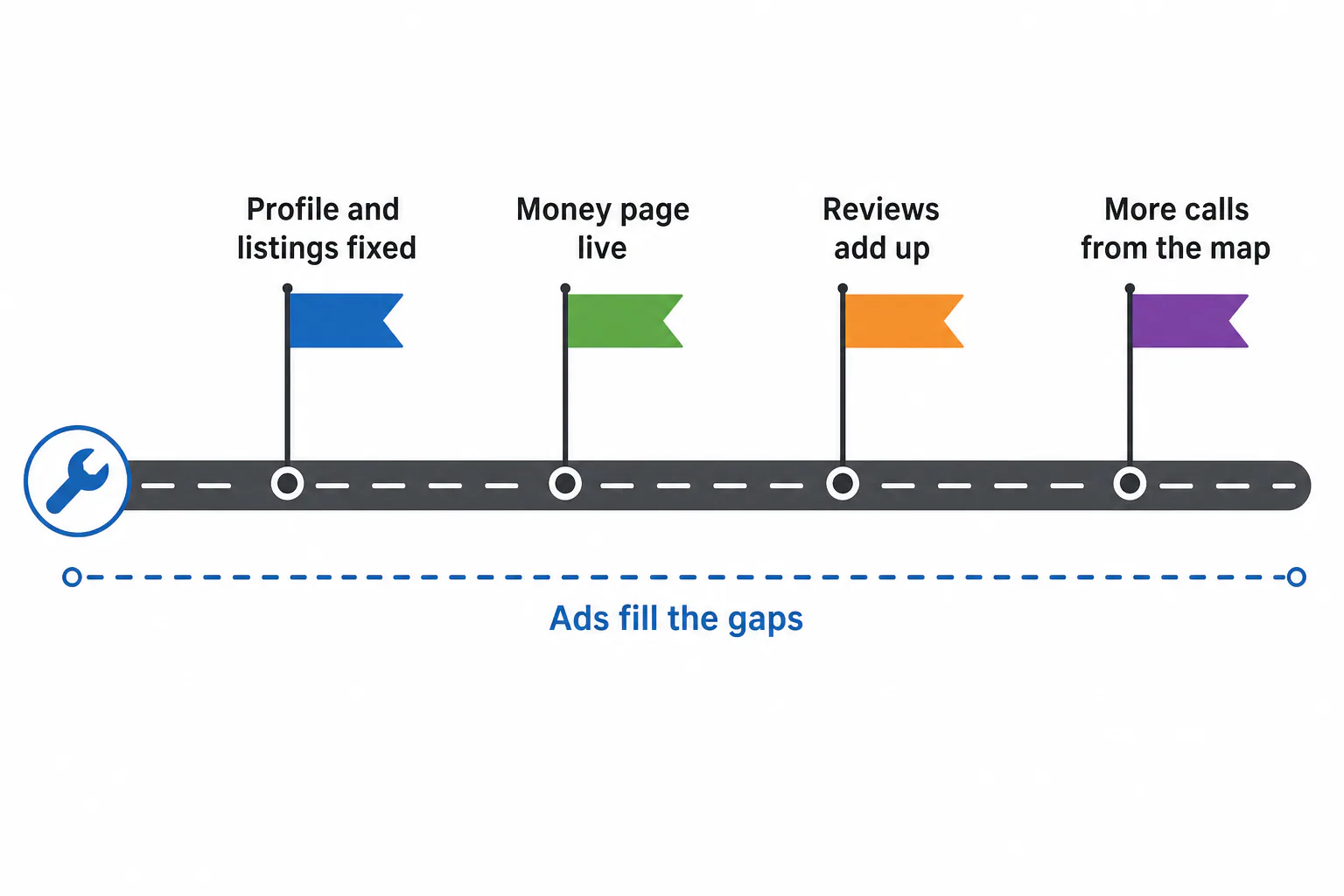
Use ads to fill gaps, like a slow month or a new service, not to replace the long-term work. When the ads stop, those calls stop too, while the profile and pages you built keep doing their job.
Affordable SEO and Website Plans from Websites San Diego
We’re Websites San Diego, a San Diego digital agency offering website design, SEO services, content writing and other digital marketing. After 30 years of helping local companies, we keep everything in plain language. We don’t promise rankings, traffic or a set number of leads.
SEO and GEO marketing from $159 a month
Our SEO and GEO marketing starts at $159 a month and covers setting up and maintaining your Google Business listing, placement in local directories and white-hat SEO. It’s the lower level described above, our affordable SEO for small business: the groundwork that gets your website SEEN where local customers look first.
Blog writing and keyword SEO from $129 a month
Our blog writing and tailored keyword SEO starts at $129 a month, with SEO-optimized blog content built around tailored keywords and posted to social media. Add it once your profile is in shape and you want more traffic and leads from the questions customers actually ask.
Website development from $99 a month
We take a website from concept and design all the way to the final SEO campaign, so you’re not coordinating a designer, a developer and a marketing firm. After launch, we stay on for maintenance and support. Ask us for the exact price. Our digital marketing consulting covers business analysis, strategy development and continuous monitoring.
The easiest first step costs nothing: request a free SEO review of your website from Websites San Diego. We’ll look at where you stand and tell you straight which budget level fits and what to fix first.
Frequently Asked Questions
Do affordable SEO services really exist?
Do affordable SEO services really exist?
Yes, as long as “affordable” means paying for the right few tasks rather than everything at once. Some local plans, ours included, start under $200 a month and focus on your business profile, directory listings and on-page work. What they won’t cover at that price is heavy link building or a stream of new content. Those come at higher budgets.
How long does it take for affordable SEO to show results?
How long does it take for affordable SEO to show results?
It depends on your competition and where you start. Fixing an incomplete profile can bring more map views within weeks. Rankings for website pages usually take several months, because search engines need time to revisit pages and see reviews build. Be wary of any agency promising fast results; the honest ones explain what to track instead of naming a date.
Is cheap SEO worth it or will it hurt my website?
Is cheap SEO worth it or will it hurt my website?
A low price on its own won’t hurt your website; the tactics behind it can. Plans that rely on spun articles, bulk links from unrelated sites or fake reviews can lead to penalties and lost visibility that take months to undo. Cheap SEO is worth it when the tasks are listed, the work is white-hat and your accounts stay in your name.
What are the best free SEO tools for small businesses?
What are the best free SEO tools for small businesses?
Start with Google’s own Search Console and Analytics: one shows how your pages perform in search, the other shows where visitors come from. Add PageSpeed Insights for loading speed and Bing Webmaster Tools for Bing results. The performance view inside your business profile shows calls and direction requests. Together they cover what most small businesses need before paying for anything.
Is SEO still worth it in the age of AI search?
Is SEO still worth it in the age of AI search?
Yes. Generative AI answers still pull from websites, business listings and reviews, so a clear service page, a complete profile and consistent listings help you show up there too. People also keep clicking map results when they need a plumber or a dentist nearby. The work is the same; how results get displayed keeps changing.