

How long does SEO take for a local business? Most see first movement in Google Maps and local search within a few months. Steadier calls and leads usually take six to twelve months, depending on how crowded your market is and your website’s shape today.
Below you’ll find a month-by-month timeline, a worked example from a busy San Diego trade, and a simple keep, change or stop rule. That way you can judge for yourself whether the work is paying off. No jargon, promise.
The Short Answer: How Long Local SEO Takes to Work
Local SEO usually shows first movement in three to four months: more map views, more search impressions and a few service keywords creeping up. Steady calls and leads follow between six and twelve months. Less competition and a healthy site speed things up.
Why Google does not respond overnight
Google has to find your changes before it can reward them. Its crawler revisits pages on its own schedule, then compares you against every competitor. A fixed title might be picked up in days, but ranking higher takes longer because reviews, mentions and clicks pile up slowly.
Why no one can honestly promise a set number of days
Nobody outside Google controls its algorithm, and competitors keep moving. If the shop down the street adds fifty reviews while you add five, your timeline stretches. So we never promise a date. The honest answer to how long SEO takes for a local business is about the work itself.
What Decides Your Timeline
Four things set your pace. Here’s how to size up each one for your own business.
Competition in your local market
Competition is the biggest single factor. A dentist in downtown San Diego is up against dozens of practices with years of reviews and big marketing budgets. A piano tuner in Ramona might have three rivals, and none of them has a real website.
Here’s a quick self-check. Search your main service plus your city on your phone, then count the reviews of the top three map pack businesses. If they have hundreds, expect the long end of how long SEO takes for a local business like yours.
Your starting point: website age, history and technical health
A website with a few years of clean history already has some trust with Google. A brand-new domain starts from zero. An old site with technical problems can be even slower: unindexed pages, a layout that crawls on phones, broken links or bought spammy links. Technical optimization comes first.
Reviews, citations and consistent name, address and phone data
Reviews are one of the signals you control directly. A steady trickle of new ones (called review velocity) looks more natural than twenty in one week followed by silence.
Citations are listings of your business on other sites, like Yelp, Apple Maps, Bing Places, the BBB and Nextdoor. Your name, address and phone number need to be consistent everywhere, down to “Suite 4” versus “#4.” Mismatched details confuse Google about which listing is the real you.
Local links and content
Content tells Google what you do and where you do it. That means a separate page for each core service, pages for the areas you serve, and posts that answer real customer questions with local keywords.
Backlinks from local sources add authority and trust that a generic directory link can’t match. Think of your chamber of commerce, a Little League team you sponsor or a neighborhood news site. This slow work drives months five through twelve.
A Month-by-Month Local SEO Timeline
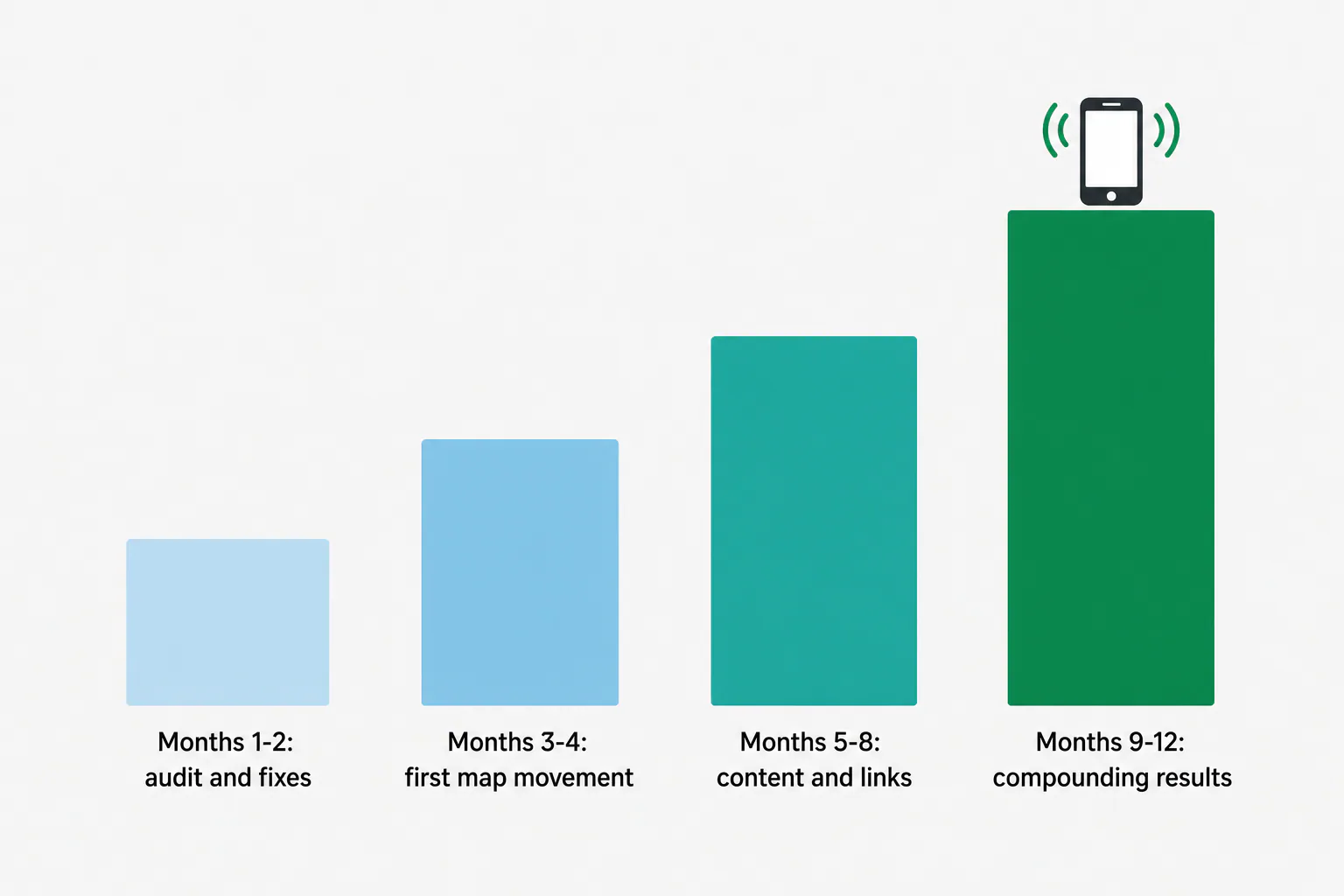
Every campaign is different, but how long SEO takes for a local business usually breaks into four stages. The table shows what gets done at each stage and what you should notice.
| Stage | What gets done | What you should notice |
|---|---|---|
| Months 1 to 2 | Audit, technical fixes, Google Business Profile cleanup, citations | Little change in rankings; listing views may tick up |
| Months 3 to 4 | Service pages live, reviews coming in | First movement in Maps and local searches |
| Months 5 to 8 | Regular content, local link building | Steadier rankings, more calls |
| Months 9 to 12 | Fine-tuning, more content | Results that compound |
Months 1 to 2: audit, fixes and Google Business Profile setup
This stage is groundwork. An audit finds what’s holding the website back, and the technical problems get fixed. Your listing gets completed: categories, services, hours, photos and service areas. Citations are cleaned up so your details match everywhere. Don’t expect ranking jumps yet.
Months 3 to 4: first movement in Maps and local searches
Map views and search impressions usually climb first. You may start showing up in the local top three for searches close to your location or for specific services, like “water heater repair” instead of “plumber.” A few extra calls are a good sign, even if they aren’t a flood.
Months 5 to 8: content, links and steadier rankings
Now regular content and local backlinks do the heavy lifting. Rankings spread to more keywords and neighborhoods, and the authority Google sees in you shows up as fewer wild swings and more consistent placement.
Months 9 to 12: compounding results and fine-tuning
Pages that rank start pulling traffic on their own, and each new post has a stronger site behind it. Growth compounds. The work shifts to fine-tuning: doubling down on the services that bring the best results and fixing pages that never took off.
How Long Before You Show Up on Google Maps
A verified listing usually appears for your exact business name soon after verification. Showing up for “electrician near me” is slower, because SEO takes months for a local business here too. It’s worth the wait: 70% of these searches happen on Google Maps, and they bring real traffic.
New profile versus an existing one
An existing listing with years of reviews and photos has history Google already trusts, so improvements show faster. A new one starts with no track record, which is why people ask how long it takes to show up on Google Maps. If Google already created an unclaimed listing for you, claim it instead of building a second one, since duplicates split your reviews.
Verification and what can delay it
Google may verify you by video, phone, text, email or postcard. Video verification, where you film your signage, tools and workspace, is now common. These things slow it down:
- an address that doesn’t match your website
- a shared or virtual office
- edits to the listing while verification is pending
- a home-based service business that shows its address instead of setting service areas
What you can speed up yourself
A few things are fully in your hands:
- Pick the most accurate primary category, then add secondary ones.
- List every service you offer, each with a short description.
- Upload real photos of your team, vehicles and finished work.
- Ask every happy customer for a review the day the job is done.
- Link the listing to the matching service page on your website.
None of this replaces backlinks over time. It is, though, the faster growth you’ll see while the slower parts of your strategy catch up.

A Worked Example: A San Diego Plumber in a Crowded Market
This example is illustrative, not a client story. It shows how one trade in a tough market might move through the year.
The starting point and the competition
Picture a three-truck plumbing company in Mira Mesa. Its website is five years old: one long page with no separate service pages. The listing on Google is claimed but half empty, with 23 reviews, and Yelp still shows an old suite number.
Competition is heavy. The top three map results for “plumber San Diego” each have several hundred reviews and years of marketing behind them. That puts this business at the long end of every range.
What changed at 3, 6 and 12 months
- At 3 months: the listing is complete, the address is consistent across directories, and pages for water heater repair, drain cleaning and repiping are live. The company starts appearing in the map pack for searches near Mira Mesa and for specific services, but not for “plumber San Diego.”
- At 6 months: steady review building (a request after every job) has pushed the count past 60. Two blog posts a month answer common questions, and a few local backlinks have come in. Calls from the map are noticeably up, though rankings still bounce week to week.
- At 12 months: the company holds the top three for several service searches in nearby neighborhoods. Citywide terms are still a stretch, but authority and growth keep building.
That slow, steady marketing strategy matches a real pattern: Local San Diego Painting consistently makes the top 3 in the Google listings, with 2 blog posts per month for over a year.
What to Measure and When to Judge the Results
Judge local SEO by phone calls, leads and early visibility signals, not by one ranking on one day.
Calls, form leads and direction requests beat rankings alone
Rankings are a means, not the goal. Calls, form leads and direction requests pay the bills, and your Google Business Profile reports all three. Add a call tracking number and ask callers, “How did you hear about us?” A tally sheet by the phone beats a dashboard nobody opens.
Map views and search impressions as early signals
In the first months, the phone may not ring much more. Watch early signals instead: views in your listing’s performance report, and impressions in Google Search Console, a free tool showing how often your pages appear in search. If those rise, leads usually follow. Check positions monthly, not daily.
A keep, change or stop rule for months 3, 6 and 12
Use this table at each checkpoint to decide what to do next.
| Checkpoint | Keep going if | Change something if | Consider stopping if |
|---|---|---|---|
| Month 3 | Map views and impressions are rising, and the agreed work was delivered | Nothing visible has changed and you got no list of what was done | Your provider can’t explain what they did |
| Month 6 | Phone and form leads are up, even modestly | Impressions are up but the phone is quiet (wrong keywords or weak pages) | No number has moved and there’s no plan to fix it |
| Month 12 | Leads cover the monthly cost and keep growing | Growth stalled: review content, reviews and backlinks | Leads still don’t cover the cost after a year of real work |

What Can Go Wrong and How to Fix It
Smooth timelines exist mostly in sales decks. These are the three problems you’re most likely to hit.
Maps rankings that rise and fall
Map pack rankings depend on where the searcher stands, so they shift by block and by day. Judge trends over four to six weeks. If a drop is sharp and lasting, look for a new competitor, negative reviews or a recent listing change.
No movement after 6 months
Start by searching “site:yourdomain.com” to confirm your pages are indexed. Then check the keywords. A small Escondido family law firm targeting “lawyer San Diego” is aiming too wide. Thin pages, few reviews and no links are other causes. Ask for a written list of monthly work.
A suspended Google Business Profile
Suspensions usually come from rule breaks: keywords stuffed into the business name, a virtual office or PO box, duplicate listings, or a home address for a service-area company. Fix the cause, then file a reinstatement request with proof, such as a license or signage photos.
Local SEO or Paid Ads: Speed, Cost and Lead Quality
Paid ads are fast, while local SEO is slow but keeps working after you stop paying. Here’s how the two compare over the same months.
| Local SEO | Paid ads (Google Ads, Local Services Ads) | |
|---|---|---|
| Speed | First movement in a few months | Visible the day the campaign goes live |
| Cost | A monthly fee for the work | Pay per click or per lead; rises with competition |
| Lead quality | Customers chose you after reading reviews and your pages | Depends on targeting; some clicks are just browsing |
| When you stop | Rankings fade slowly | The phone goes quiet right away |
Many local businesses run both. Ads keep the phone ringing early, and organic rankings lower the cost of each new customer over time, a smart strategy for steady, quality traffic. Hyper-local options like advertising on Nextdoor fill neighborhood gaps.

What You Can Do Yourself and What Needs Help
You can handle the listing, reviews and basic checks yourself. Technical work, citations and steady content production are where outside help pays for itself. If you want the bigger picture first, here is what SEO for a small business involves, what it costs and what to expect.
Tasks you can start this week
- Claim and complete your Google Business Profile, every field.
- Search your business name and fix any listing with the wrong address or phone.
- List past customers and ask a few for reviews each week.
- Open your website on your phone and make sure the phone number is one tap away.
- Write down the five services that earn the most; each one gets its own page.
Where an agency saves time
Technical fixes, citation cleanup, monthly content and tracking eat hours most owners don’t have. An agency won’t change how long SEO takes for a local business, but it can stop months being lost to trial and error and keep optimization consistent.
SEO and Content Plans from Websites San Diego
Our SEO Marketing plan is a flat monthly fee covering onsite SEO and geomarketing, Google Business setup, and local directories. Our Blog Writing and SEO content plan adds optimization-minded posts with tailored keywords. Together they build visibility and website traffic.
We handle design, development and the SEO campaign start to finish. If you’d rather start with a plan, our Digital Marketing Consulting covers business analysis, strategy development and continuous monitoring. We bring 30 years of experience, and we won’t promise rankings, just a realistic picture of your market.
Frequently Asked Questions
Can local SEO results show up in 30 days?
Can local SEO results show up in 30 days?
Some can. Fixing your listing, correcting wrong phone numbers and completing your categories can bring more views and name searches within weeks. Ranking for competitive terms like “roofer near me” in 30 days is rare, though, and nobody can guarantee it. Treat the first month as setup and judge how long SEO takes in your market at the three-month mark.
Does local SEO work for small businesses?
Does local SEO work for small businesses?
Yes, and often better than national SEO does, because you only compete with businesses in your area, not the whole country. A small shop with a complete listing, steady reviews and clear service pages can outrank bigger companies nearby. How quickly that growth comes depends on local competition and how consistently the work gets done.
How long does it take for a Google Business Profile to rank?
How long does it take for a Google Business Profile to rank?
A verified profile usually shows up for your exact business name soon after verification. Ranking in the map pack for service searches, like “dentist Chula Vista,” typically follows the same path as the rest of local SEO: early movement in a few months, steadier positions later. Reviews, photos and accurate categories make the biggest difference.
Is SEO still worth it in the age of AI search?
Is SEO still worth it in the age of AI search?
Yes. AI answers in search pull from websites, reviews and business listings, which are the same things local SEO builds. A clear website that says what you do and where, plus a well-kept listing with real reviews, gives AI tools trustworthy information to repeat. Skipping that groundwork leaves them with nothing about you to show.
What is the difference between local SEO and organic SEO?
What is the difference between local SEO and organic SEO?
Local SEO aims at the map pack and “near me” searches, and it leans on your Google listing, reviews, citations and how close you are to the searcher. Organic SEO aims at the regular results below the map, and it leans on website content and backlinks that build authority. For a local business, the two overlap and support each other.
How much does local SEO cost?
How much does local SEO cost?
It depends on your competition and how much work your website needs. More services, more locations and a crowded market all mean more pages, links and reviews to build. Our SEO Marketing plan starts at $159 a month, and blog writing with SEO content is $129 a month. Ask any provider for an itemized list of what the monthly fee covers.