

Is SEO still worth it in the age of AI search? For most small local businesses, yes, but its job has changed. Some clicks vanish into AI summaries, and some businesses feel it more. We’ll show you who gets hit and where your money works hardest.
The Short Answer: Yes, but the Job of SEO Has Shifted
Yes. Search engines and AI tools like ChatGPT, Gemini and Perplexity still pull from web pages that are easy to crawl, trusted and clearly structured. SEO makes your pages those sources. The new goal: get named inside AI replies, not only ranked.
For two decades, SEO had one main job: get your page high enough that people click. That job still exists. Now a second sits on top: give AI-driven search tools content clear enough that they repeat it and name your business.
What the shift means for a small business
You’re now writing for a customer and for a machine that summarizes things for that customer. Both want a fast, specific reply from real experts. That moves the focus from exact keywords to search intent, in a few concrete ways:
- Pages built around the topics customers actually ask about. This builds topical authority, where the old approach was a page stuffed with keywords.
- Visible expertise: real project photos, the neighborhoods you serve, and the licenses and training you actually hold.
- Consistent details everywhere you appear, from your business profile to directories and social media.
- Short, direct replies near the top of each page, because that’s the part engines quote.
The owners who struggle are the ones still paying for a monthly report full of rankings and keyword positions that nobody connects to phone calls.
What has not changed
People still need to find you, trust you and call you. Search engines still crawl pages, judge their quality and decide what to show. A slow site with thin content didn’t rank five years ago, and it won’t get quoted by an AI tool today.
What wins local customers hasn’t changed either: a complete business listing, steady reviews, and a fast website that says what you do and where. Google says its foundational SEO practices still apply to its AI features, so steady optimization still pays off.
What AI Search Changes and What It Leaves Alone
AI-driven search changes the most for quick, factual questions and the least for people who need a business near them right now. That split decides whether you should worry.
Zero-click searches and fewer clicks from AI Overviews
A zero-click search is one where the user gets the answer on the results page and never visits a site. AI Overviews make this more common for informational topics, like “how long does exterior paint need to dry.” Organic click-through rates for the pages below tend to drop.
We won’t give you a percentage for lost traffic, because it depends on the query. Still, the pattern answers whether SEO is still worth it in the age of AI search: summaries satisfy homework questions, while “I need someone to fix this” ends in a call.
Why AI tools still rely on pages that rank, load and earn trust
Large language models (LLMs) don’t make up the plumber down the street. For current or local questions, ChatGPT, Gemini and Perplexity often run a web search and summarize what they find. A page that can’t be crawled or shows no expertise is a poor pick.
That’s why rankings and AI visibility tend to move together. A large study found strong classic rankings go with more AI citations, though that shows correlation, not cause. Quality signals like relevance and authority make you a safer source, even for long conversational voice questions from a user.
Local searches, Google Maps and reviews
Local searches have changed the least. Someone typing “emergency electrician near me” wants a name, a rating and a phone number, and the map pack puts those up front with a call button. AI tools answering local questions lean on the same profile data, reviews and website details.
That’s why we push owners toward their Google Business Profile. As we’ve noted, 70% of these searches happen on Google Maps. Reviews matter as much as before, since a summary saying “highly rated for fast service” has to come from somewhere.
Traditional SEO, AEO and GEO Side by Side
Traditional SEO aims for a high position in the ranked list. AEO (Answer Engine Optimization) aims to be the one direct reply. GEO (Generative Engine Optimization) aims to get you cited inside an AI-written response. All three share most foundations.
A short comparison table
Here’s how the three approaches compare on the points that matter to a small business:
| Traditional SEO | AEO | GEO | |
|---|---|---|---|
| Goal | A top position in the regular listings and map pack | Be the direct reply to a specific question | Be named or cited in AI-written responses |
| Where it shows | Blue links, map pack | Featured snippets, voice assistants, AI Overviews | ChatGPT, Gemini, Perplexity, AI Overviews |
| What you work on | Technical SEO, keywords, links, reviews | Question-shaped headings, short clear replies, FAQ markup | Clear facts, brand mentions, experience and expertise shown on the page |
| Query style | Short phrases (“roofer San Diego”) | Questions (“how long does a tile roof last”) | Long, conversational requests |
| How you measure | Rankings, clicks, calls | Snippet wins, impressions | Manual checks of AI tools, branded searches |
| How proven | Well understood | Partly proven | Early, still emerging |
Notice the overlap. The technical work and trust signals in the first column feed the other two. The key difference between traditional SEO and AI SEO is the target: classic work is driven by where you rank, the newer work by whether a tool repeats you.
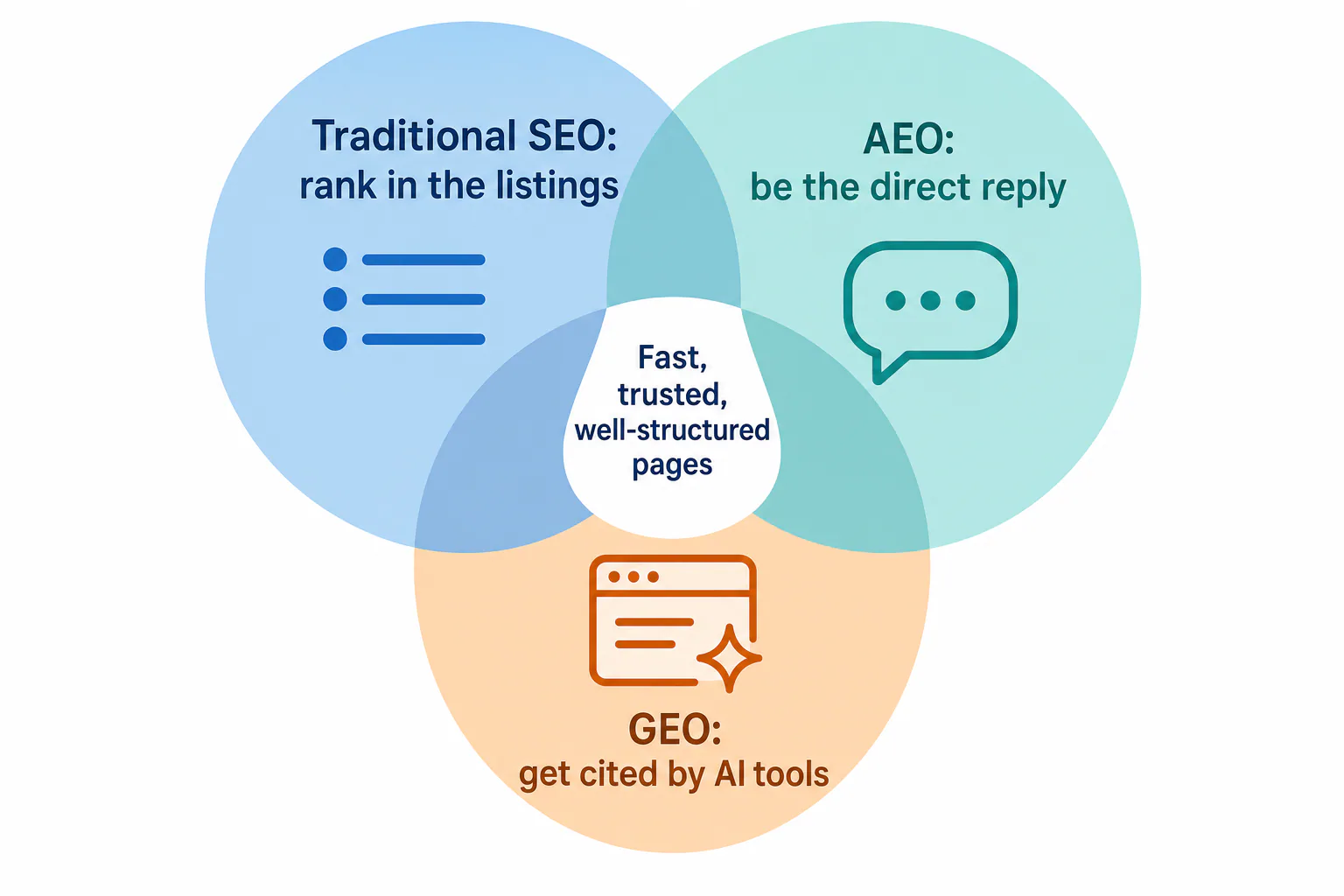
What is proven and what is still guesswork
Here’s what is proven: solid technical SEO, helpful pages written from real experience, accurate business listings, reviews, and mentions on other trusted websites. These have worked for traditional rankings for years, and they’re what AI tools draw on now.
Here’s what is still guesswork:
- Special files or code that promise to control what large language models say about you.
- “Prompt-ready” content packages.
- Any service selling GEO as a guaranteed method.
Mentions on social media and in local news may help AI tools recognize your brand, but nobody has published a reliable formula. Conversational phrasing helps people and machines read your page, but it isn’t magic. If someone promises a ChatGPT citation by next month, walk away.
Does SEO Pay for Your Type of Business? A Decision Rule
Here’s our rule for whether SEO is still worth it in the age of AI search for your business. If a customer has to choose a provider and each job is worth real money, SEO still pays. If you earn mostly from quick-fact readers, rethink your strategy.
A quick way to place yourself:
- Keep investing if people search for your service plus a place, compare a few options before they call, or spend real money on each job.
- Shift some budget if your traffic comes mostly from how-to articles and very little of it ever turns into calls or sales.
Where SEO still pays: local, high-intent and considered purchases
Local services, high-intent searches and considered purchases show why SEO is still worth it in the age of AI search: the intent ends in hiring someone. A summary can explain a leaking water heater, but it can’t replace it. Searching “water heater replacement Chula Vista same day” means ready to act.
Considered purchases work the same way. A homeowner planning a remodel will ask an AI tool conversational questions, then check reviews and photos. Your optimization plan is simple: show up in that research with clear price factors, real work and solid reviews.
Where it pays less: sites that live on informational clicks
Sites that live on informational clicks take the biggest hit. Think recipe blogs, trivia pages and generic how-to publishers paid by ad views. If the summary gives away the whole reply, the user has no reason to visit.
Some small businesses see a milder version. If your blog ranks for broad topics far from what you sell, those visits may shrink, which is fine if they never produced customers. Don’t stop SEO. Move effort to pages tied to buying intent and judge content by calls and leads.
The honest downsides: lost clicks, slower payback and tradeoffs
We’d rather you hear the downsides from us than find them on an invoice:
- Lost clicks are real. Informational posts that used to bring visitors may bring fewer, even when your position doesn’t change.
- Payback is harder to see. Some of the value now shows up as people who saw your name in a summary and searched for you later, which is tough to credit.
- Each page takes more work. Thin, generic pages don’t cut it. You need photos, specifics and real experience.
- Money spent here isn’t spent on ads. Ads bring calls the day you turn them on and stop the day you stop paying. SEO builds slowly and keeps working, but it’s never guaranteed.
For a local service business, the tradeoff usually still favors SEO as part of the user’s path to hiring you. Just go in knowing it’s a long game and results vary.
How to Get Your Business Cited in AI Answers
You can’t force ChatGPT or AI Overviews to cite you. You can make your pages the clearest, most trustworthy source for the questions your customers ask. These five steps cover how to get your content picked by AI-driven search tools without chasing tricks.
Write for real questions, not keyword counts
Start with the questions people ask when they call, and write down the last twenty. A pool company might hear “why is my pool green after rain.” Each deserves a clear, direct reply on your site that matches the user intent behind it.
Use keywords the way customers say them, in a plain conversational tone. Build topical authority by covering related topics around each service: costs, timing, common problems. When pages cover a subject that well, engines and AI tools treat you as a stronger source.
Show experience and authority (E-E-A-T)
E-E-A-T stands for experience, expertise, authoritativeness and trust, the qualities Google’s quality guidelines describe for good content. For a local business, showing it is mostly about proof:
- Photos of your own jobs, not stock images.
- Project details: the neighborhood, the problem, what you did and how long it took.
- The owner’s name and background on the About page, plus any licenses or certifications you actually hold.
- Reviews that mention specific services. Encourage these by asking customers to say what you did.
First-hand experience and expertise are exactly what a generic article can’t fake. They’re what build authority with people and machines alike, and they feed your topical authority.

Use clear structure, FAQs and schema markup
AI tools pull short, self-contained passages, so make those easy to find. Use headings that match real questions and put the direct reply in the first sentence or two under each. Add an FAQ section to service pages, and keep paragraphs short for people skimming on a phone.
Schema markup is code that labels your page for search engines with your business name, address, hours, services and FAQs. LocalBusiness and FAQ data help engines understand who you are. It won’t guarantee rankings or a citation, but vague, unlabeled pages give a tool little to work with.
Fix the technical basics first
None of this matters if your pages can’t be crawled or take forever to load on a phone. Technical SEO is the plumbing:
- A mobile-friendly design and fast load times.
- HTTPS and no broken pages.
- A clean sitemap submitted to Search Console.
Check that your important pages are indexed, and that internal links connect your service pages to each other and to your area pages.
Good technical SEO won’t make weak content rank, but bad technical SEO can sink strong content. Fix it once, then check it every few months.
Use AI tools for content without hurting your rankings
AI writing tools can help you draft faster. Search engines care more about whether a page is helpful and accurate than about how the first draft was made. The real risk is publishing generic, mass-produced content that says what every other page says. Here’s a practical routine:
- Use the tool for an outline or a rough draft.
- Add your own experience: the jobs you’ve seen, local quirks, mistakes customers make.
- Fact-check every claim and remove anything you wouldn’t say on the phone.
- Read it out loud in your own voice before it goes live.
How to Measure SEO When Clicks Are Not the Whole Story
Track what makes you money (calls, form leads and bookings) next to organic clicks, because clicks alone now undercount what SEO does. A visit you never got because of an AI summary can still turn into a call next week. That’s AI visibility working, even if no chart shows it.
What to track: organic clicks, branded searches, calls and assisted conversions
These four numbers give you a fuller picture than traffic alone:
- Organic clicks and impressions in Search Console. Rising impressions with flat clicks often mean you’re showing up, but the summary is handling the quick question.
- Branded searches: how often people search your business name. If AI tools mention you, this tends to grow.
- Calls, direction requests and website clicks from your business profile, plus calls and forms from your website.
- Assisted conversions in your web analytics: visitors who first came through organic search and converted later through another channel.
That mix tells you whether your optimization strategy works for the user who never clicks as well as the one who does. Lead quality counts too, so ask new callers how they found you and write it down.
A simple monthly check for AI mentions
No tool reports AI citations perfectly yet, so a simple manual check does the job:
- List ten questions a real customer would ask. Mix service questions (“best AC repair in Santee”) with how-to ones.
- Ask each one in ChatGPT, Gemini and Perplexity, then run it as a normal search to see the AI Overview.
- Note whether your business is named, whether your page shows up as a source, and which competitors appear.
- Record everything in a spreadsheet with the date.
- Repeat the same questions on the same day each month.
Replies vary from person to person and day to day. Look at the trend over several months, not one result.
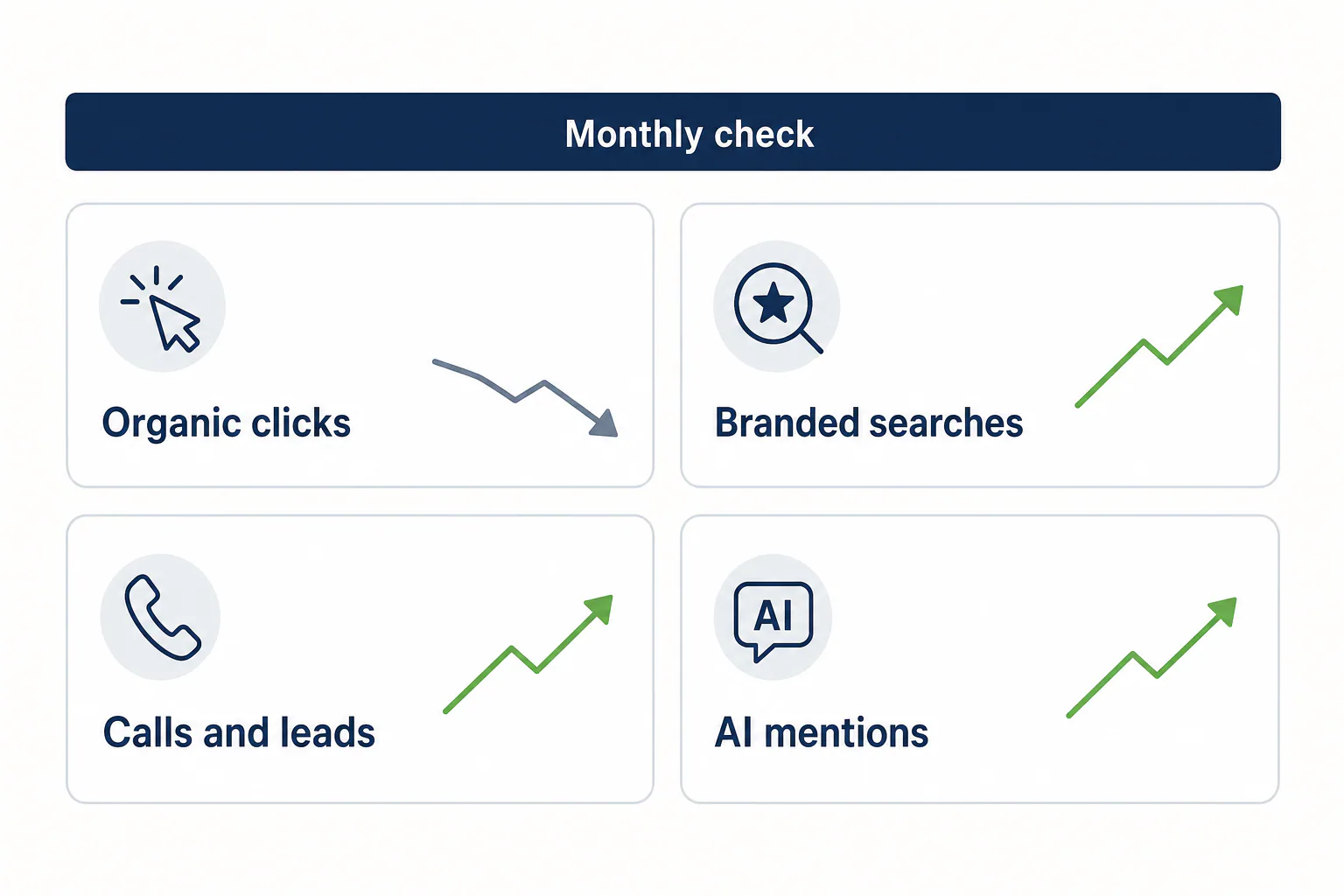
A worked example for a San Diego service business
Here’s an illustrative example, not a real client. Picture a small plumbing company in La Mesa that has spent a year on SEO. Its monthly sheet has four rows: organic clicks, branded searches, calls from the business profile, and AI mentions from the ten-question check.
Over six months, clicks to its general how-to posts slip, because summaries now cover “how to unclog a drain.” On its own, that looks like failure. The other rows tell a different story:
- Branded searches climb.
- Calls from the profile hold steady or rise.
- The company starts appearing in Perplexity for “tankless water heater install La Mesa.”
So the owner shifts effort from broad posts to service and area pages, and keeps the digital marketing budget where the calls come from.
For a real reference point, our client Local San Diego Painting consistently makes the top 3 in the Google listings, with 2 blog posts per month for over a year. Steady, relevant content is still how a local business builds that kind of visibility.
Where to Spend a Small Budget in the AI Era
With limited money, fix what feeds both the regular listings and AI tools first: your business profile and website basics, then one strong page per service, then steady content. A smart small-budget strategy skips the flashy “AI SEO” packages until those are done.
A priority order for limited money
If you can only do a few things, do them in this order:
- Business profile. Complete every field, pick the right categories, add real photos and post updates. It’s free, and it drives map results.
- Reviews. Ask every happy customer, and reply to every review, good or bad.
- Website fixes. Cover the technical SEO basics: speed, mobile layout, working forms, a click-to-call phone number and clean internal links.
- Service and area pages. Build one clear page per service and per main area you serve, each with real photos and an FAQ, connected through your internal navigation.
- Structured data. Add LocalBusiness and FAQ markup to the pages that matter.
- Steady content. Publish one or two helpful posts a month that answer customer questions. Add listings in local directories to earn mentions and a link or two.
This order works because each step makes the next one more effective, and each one is a small piece of optimization the user will notice. A great blog post on a slow website with no reviews does far less than it should.

SEO, blog content and website plans from Websites San Diego
If you’d rather not do this yourself, it’s the work we do. Our SEO Marketing plan is a flat monthly price covering onsite SEO, Google Business setup and local directories. Our blog writing and SEO content plan is flat-priced too. See local SEO vs organic SEO for how local SEO services differ. To see how the pieces fit together, read our guide to SEO for a small business, including costs and what to expect.
We handle design, development and the SEO campaign, in plain words. After 30 years online, the straight truth is that nobody can guarantee rankings. So is SEO still worth it in the age of AI search? Yes, because we can set your site up to be seen.
Where Search Is Heading and Will AI Replace Digital Marketing?
Search is heading toward more AI summaries, more conversational questions and more weight on brands people already trust, but the basics underneath stay the same. Here’s what we expect, without pretending to know exact timelines:
- AI summaries will show up on more topics, including some local ones.
- Queries will keep getting longer and more conversational, especially by voice. Matching the intent behind the full question will count for more than exact-match keywords.
- Brand mentions, reviews and a recognizable name will carry more weight, because AI tools prefer sources they see referenced across the web.
- Traditional ranking signals such as crawlability, relevance and trust will keep feeding every new AI-driven search feature.
Will AI replace digital marketing? No. It automates pieces like drafting, reporting and ad bidding, but someone still has to set the strategy: what you offer, who you serve and how your website earns trust. A business still has to be worth recommending.
Keep paying for SEO if it’s aimed at your business profile, your service pages and real proof of your work. Stop paying for reports that only count keyword positions. Start with the priority list above, run the ten-question AI check this month, and see where you stand.
Frequently Asked Questions
What impact does SEO have on search results?
What impact does SEO have on search results?
SEO decides how easily search engines can find, understand and trust your pages. That affects whether you appear in the regular listings, the map pack and AI summaries. It can’t buy a spot, and nobody controls the order. What it does is remove the reasons a search engine would skip you: slow pages, unclear content, missing business details or no proof of quality.
Is SEO still worth investing in for small businesses?
Is SEO still worth investing in for small businesses?
For most local and service businesses, yes, as long as the money goes to the things that bring calls. That means your business profile, reviews, a fast website and clear service pages. It’s a weaker bet if your only goal is traffic from general how-to articles. A small budget spent in the right order usually beats a big one spent on vanity metrics.
Does SEO still matter for local businesses with Google Maps?
Does SEO still matter for local businesses with Google Maps?
Yes, and the map is where it matters most. Your map position depends on relevance, distance and prominence. You can influence the first and last with a complete profile, consistent listings, reviews and a strong website. AI tools that handle local questions lean on that same data, so local SEO now helps you in two places at once.
Is SEO still worth it in 2026?
Is SEO still worth it in 2026?
Yes. In 2026 the work looks different from a few years ago, with less chasing of exact keywords and more answering real questions with proof and clear structure. AI Overviews and chat tools have reduced clicks on some informational topics, but they still depend on pages that rank and earn trust. If you sell a service people choose carefully, SEO remains one of the steadiest channels you can build.
Will digital marketing get replaced by AI?
Will digital marketing get replaced by AI?
No. AI is replacing some tasks inside digital marketing, like first drafts, reporting and bid adjustments, but not the decisions behind them. Somebody still has to know your customers, your prices, your service area and what sets you apart. Then they have to make sure that shows up consistently on the web. Think of AI as a faster tool in the kit, not a replacement for a strategy.