

Content marketing for small business means publishing helpful answers to the questions people already type into Google, mostly as pages on your own website, so they find you, trust you and call you. It costs little in dollars and a lot in consistency.
Local San Diego Painting shows content marketing for small business at work: it consistently makes the top 3 in the Google listings, with 2 blog posts per month for over a year. No viral moment, no giant ad budget, just steady, useful pieces. Below you’ll find the steps in order, what it costs, how long it takes and when it won’t pay off yet.
What Content Marketing for a Small Business Actually Is
Content marketing is a marketing strategy for earning customers by being useful in public, before anyone asks you for a quote. For a small business, it is a low-cost marketing strategy built on answers.
The idea in plain words
People have questions long before they hire anyone. A homeowner in Clairemont wonders how long exterior paint lasts near the ocean. A café owner in Hillcrest wants to know how often a grease trap needs cleaning. If your website answers that better than anyone else, Google can show your page, the reader learns something and your name sticks with your audience.
You find the questions your audience asks, answer them in plain words and keep doing it. The answers can be written pages, short videos or emails, but for most small businesses the written answer on their own site does the heavy lifting.
Why it works: trust, visibility and lower cost per customer
Useful answers make people trust you, because they’ve already seen that you know the job, and people buy from a brand they’ve learned something from. Over time, that trust becomes your brand’s best asset. You also show up on Google for questions you’d never pay to advertise on.
The cost side is why small businesses stick with it. A page you write once can bring in traffic and calls for years, so it’s lead generation that keeps running after you stop paying, and the return grows with every page you add. An ad stops the minute the budget runs out.
How it differs from ads and from social media posting
Paid ads, social media and content marketing all put your name in front of people, but they run on different clocks. Ads buy reach; useful pages earn it. Here’s how the three compare:
| Paid ads | Social media updates | Answers on your website | |
|---|---|---|---|
| You pay with | Money per click or view | Your time, several times a week | Your time or a writer’s fee, once per piece |
| How long it works | Only while you pay | Until the feed moves on | As long as the answer stays accurate |
| Who sees it | People the ad targets | Mostly your current followers | Anyone who types the question into Google |
Social media is good for staying in touch with people who already know you, and for engagement with them. A page on your site is what a stranger finds on the day they need you.
How Do You Create Content for Your Business? The Steps in Order
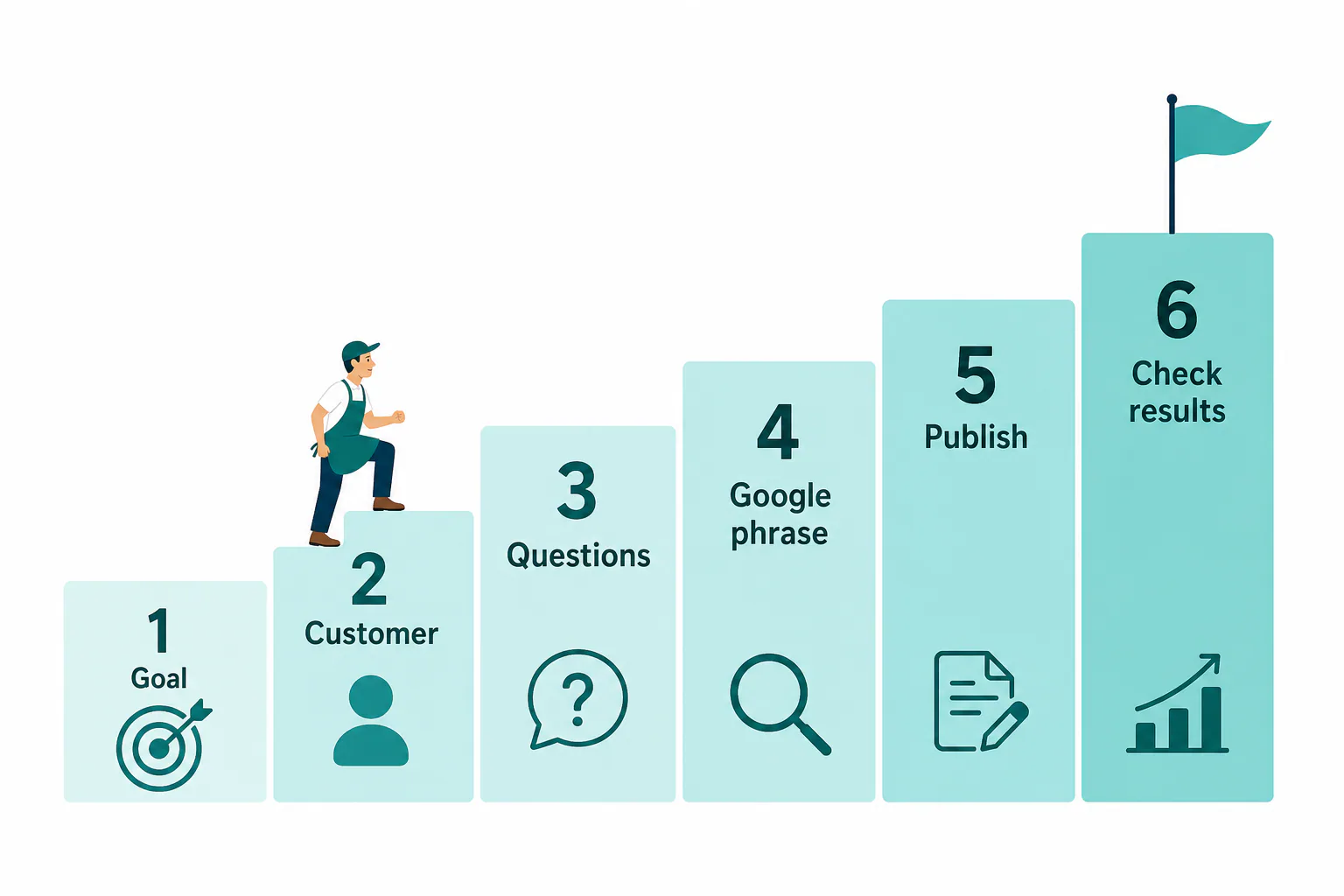
You create content for your business by working through six steps, in this order:
- Pick one goal you can measure, such as quote requests from your website.
- Describe the person looking for you and what worries them.
- Collect the real questions people ask you on calls, in emails and on jobs.
- Match each question to the plain phrase people type into Google.
- Write, publish and update one answer at a time, on a schedule you can keep.
- Share it. Then measure what it brought in against your goal.
Step 1: Pick one goal you can measure
Skip goals like “get more exposure.” Choose one number you can measure every month: calls from the website, quote form requests or visits to your service pages. For a local service business, lead generation is usually the right goal, and it anchors your content strategy. Write it down with this month’s figure next to it, so in six months you know what success looks like instead of guessing.
Step 2: Describe the customer who is searching
Skip the thick buyer persona document. On one page, write who calls you, where they live, what problem pushed them to look for help and what worries them. A pool service might write: “Homeowner in Rancho Bernardo, 40s to 60s, green pool a week before a family party, worried about being upsold.” That keeps every piece, and your brand voice, aimed at a real audience.
Step 3: Collect the questions customers ask
Your best topic list is already in your phone and inbox. For two weeks, jot down every question a customer asks: on calls, in emails, at the job and in online reviews. Ask your crew to do the same. Then run your main service words through a free tool like AnswerThePublic, which shows the questions people type around a phrase such as “roof repair.” You’ll likely end up with more ideas than you can write in a year.
Step 4: Match each question to a search phrase
Type a question’s main words into Google and check three places: the suggestions that drop down as you type, the “People also ask” box and the related searches at the bottom. Pick the plainest wording a caller would use, like “how often to pump a septic tank” rather than “septic maintenance intervals.” One question, one phrase, one page. That’s your whole keyword research system for now.
Step 5: Write, publish and update on a schedule
Pick a pace you can hold for a full year and put the dates on a calendar. Two pieces a month is plenty, and it’s the rhythm behind the Local San Diego Painting example: 2 blog posts per month for over a year. Reopen older pages every few months and update prices and photos; steady updates drive growth and long-term success for content marketing for small business.
Step 6: Share it and check what happened
Share each new piece once on your Google Business Profile, once in your email newsletter and once on your one social platform. Once a month, check how many people visited, how many called or filled in a form, and which phrases brought them in. Google Search Console is free and shows the phrases; Google Analytics shows traffic and form fills on your site. Compare it all with your Step 1 goal.
Business Blog Strategy: Choosing Your Formats and Channels
A good business blog strategy for small businesses is narrow: one home base, one or two ways to share it, and nothing more until those run smoothly and show growth. Keep that strategy simple enough to follow.
Why the blog comes first for most local businesses
Your website is the one channel you own. Social platforms change their rules and your reach overnight, and an email list needs something worth sending. Answers on your site meet people who type a problem into Google, feed your newsletter and show visitors you know your trade. For a plumber, a landscaper or a dental office, people go online first and your brand should be there.
A decision rule for picking two or three channels (blog, email newsletter, one social platform)
Start with your site, then add one or two channels based on where your audience already spends time. Use this rule:
| Channel | Add it if | Skip it for now if | Effort |
|---|---|---|---|
| Blog on your website | People look up your service on Google before they call | Almost nobody types your service into Google | Medium, steady |
| Email newsletter | You have repeat or seasonal buyers: HVAC tune-ups, pet grooming, tax prep | Most people buy once a decade, like a new roof | Low |
| One social platform (Facebook, Instagram, Nextdoor or LinkedIn) | Your work looks good in photos or your buyers are neighbors who talk | There’s no local community there to talk to | Medium |
| Short videos | Showing beats telling: before-and-after jobs, quick fixes | Nobody on the team will get on camera | Higher |
A pest control company might run its site, a newsletter and Nextdoor, while a kitchen remodeler picks its site plus Instagram. Success here means one channel that brings calls, not five that bring likes. If you’d rather hand that part off, our Social Media Management service covers posting schedules, content and integrated social media advertising.
Where video and other formats fit when you have little time
Video doesn’t need a studio. A short phone clip of a finished job, or you answering one common question, works fine, and you can embed it in the matching page so both help each other. Treat videos, galleries and checklists as add-ons to a written answer. Film only when a topic is easier to show than explain, like resetting a garage door opener.
Two more formats match what people already search for. A comparison post helps a buyer decide, like a plumber’s “repair vs replace a water heater” piece. A seasonal post fits repeat buyers, like an HVAC “fall tune-up checklist” or a landscaper’s “when to trim palm trees” article. Both fit alongside your regular blog posts.
Blog Marketing for Local Business: Getting Found Nearby
Blog marketing for local business works when every piece points back to a place you serve and a service you sell, which is content marketing for small business at its most practical.
Local keywords and service-area pages that support your posts
Add the place to the phrase where people would: “water heater replacement Escondido,” “mold inspection Chula Vista.” Then build one service-area page for each main area and link every related answer to it. The answer explains; the service page closes the deal with your phone number, photos and reviews. This onsite groundwork is part of geomarketing, and it’s where your online visibility in each neighborhood starts.
Team up with a neighbor. A plumber and a water heater installer can co-publish a post or share each other’s pages, so each one reaches a new audience that already trusts the other. Cross-promoting like this builds your local community and sends more people to both sites, which is a cheap way to win new leads.
Using Google Business Profile posts alongside your blog
Your Google Business Profile lets you publish short updates that appear on your listing in Google Search and Maps. That matters, because 70% of these local searches are done on Google Maps. For each new piece, write a three-sentence version, add a real job photo and link back to the full page. One piece of work gives you engagement and website visits.

Writing about San Diego neighborhoods, jobs and customer cases
Local detail is the one thing generic national pages can’t copy. Write about jobs you actually do: “Repainting a 1920s Craftsman in North Park,” “What salt air does to wrought iron railings in Ocean Beach.” Customer cases work too: the problem, what you did, photos and what drove the cost. Ask permission before naming anyone. Posts like these earn trust and engagement in community groups.
SEO Blog Writing: How to Write Posts That Can Rank
SEO blog writing comes down to writing the best answer to one question and making that answer easy to spot, for readers and for Google.
Keyword research a non-expert can do
You already have the method from Step 4. To judge your chances, look at who’s on page one now. If it’s national giants like Home Depot or WebMD, add your city or narrow the angle. Local shops with thin pages mean a real shot for content marketing for small business. Paid tools like SEMrush help, but you don’t need one to start.
Structuring a post: headings, answers, internal links
Use this template for every piece you write:
- A title that uses the reader’s own phrase in plain words
- The answer in the first two sentences, with no warm-up
- Headings that each cover one sub-question, so skimmers find their part
- One real example, photo or cost driver from your own jobs
- A link to the matching service page and one to a related page
- A clear next step at the end: call, book or request a quote
Internal links move visitors toward a call. The return you want from each article isn’t the visit alone; it’s the click to your service page and the call after it.
Common SEO writing mistakes
These are the mistakes that hold pages back most often, each with its fix:
- Stuffing the phrase into every sentence. Use it in the title, the opening and a heading, then write like a person.
- Writing 300 words that never answer the question. Answer it first, then add detail.
- Targeting a phrase nobody uses, like your internal product name. Use the words callers use.
- Copying a competitor’s page. Add your own jobs, photos and prices.
- Publishing without links to a service page. Every piece should lead somewhere you can be hired.
Content Calendar for a Small Business: A Sample 90 Days
A content calendar for a small business only works if it’s realistic and has a name next to every task.
How many posts you can realistically keep up
If you write alone, two pieces monthly is a pace you can usually hold; one a week works only when someone else writes most of it. Pick the lower number. Two good pieces a month for a year beat eight in March and nothing after. In a tight month, one piece plus a profile update keeps your content marketing for small business alive.
A worked 90-day calendar for a local service business (topics, owner, weekly hours)
Here’s a sample for a made-up San Diego landscaping company, built on two pieces a month. The hours are our planning assumption for an owner writing with an office manager’s help; time your first few and adjust.
| Weeks | Task or topic | Who | Hours that week |
|---|---|---|---|
| 1-2 | Set the goal, sketch the buyer, collect questions, pick 6 phrases | Owner | 2 per week |
| 3 | “Drought-tolerant plants that survive Poway’s summer heat” | Owner writes, office manager adds photos | 3 |
| 5 | “What changes the price of artificial turf in San Diego” | Owner | 3 |
| 7 | Case: “Replacing a thirsty front lawn in Clairemont” | Office manager drafts, owner checks | 2 |
| 9 | “When to trim palm trees, and when to wait” | Owner | 3 |
| 11 | “Fall irrigation timer settings for coastal yards” | Owner | 3 |
| 13 | Review the numbers, update the first piece, plan the next quarter | Owner | 2 |
| Every week | One Google Business Profile update, one Facebook or Nextdoor share | Office manager | 1 |
What Content Marketing Costs and How Much Time It Takes
Content marketing for small business costs you hours, a monthly fee or some of both. The dollar side can stay modest. The real price is keeping your marketing strategy going for a full year.
Your hours versus hiring it out
To find your own figure, add up the time one piece takes: picking the phrase, writing, photos, publishing and sharing. Multiply that by your monthly pieces, then price those hours at what a billable job pays you. If that beats a writer’s fee, writing yourself is the expensive option. Owners booked solid usually shouldn’t, and a hired writer is a smart marketing strategy for them.
What the blog writing and SEO services cost at Websites San Diego
Our Blog Writing and SEO content service is a flat monthly fee for SEO-optimized blog posts with tailored keywords, posted to social media. If your website also needs the groundwork, our SEO Marketing plan is the next step up. It covers onsite SEO, geomarketing, Google Business setup and maintenance and placement in local directories.
What a quote or a freelancer should spell out
Before you sign with anyone, get these points in writing:
- How many posts you get per month, and roughly how long each one is
- Who picks the topics and phrases, and whether you approve drafts
- Whether photos, publishing, internal links and sharing are included
- Whether newsletters or profile updates cost extra
- Which lead numbers they report each month, and that you own everything they write
Walk away from anyone who guarantees a ranking. Nobody controls Google.
Content Marketing Results: Timelines, Proof and When It Does Not Pay Off
Content marketing for small business builds results slowly and then keeps paying. Plan in quarters, not weeks, and judge progress by small signals before the calls arrive, since lead generation takes time to show.
A real example: Local San Diego Painting reaches the top 3
The painting company now consistently makes the top 3 in the Google listings. What it shows is the pattern. Each new answer added one more phrase the business could appear for, and over a year the pages backed each other up. No single post did it, and results like this vary from business to business.
How long results usually take, and the metrics to watch in the meantime
Expect the first months to look quiet. Before calls come in, watch these signs in order:
- Impressions in Google Search Console: your pages start showing up for searches
- Clicks, and which phrases bring them
- Visits from those pages to your service pages
- Calls and form requests measured against your goals
Reach on social media is nice, but growth in search impressions is the earlier, more honest signal. Engagement on a page, like clicks to your service page, is the next one.
When paid ads or a website fix should come first
Content can’t fix a website that loads slowly, hides your phone number or looks broken on a phone; repair that first, or every visit leaks away. Paid ads fit when you need calls this month, open a new location or few people search for what you sell. Many owners run a small ad budget while answers earn their place.
Mistakes That Stall a Business Blog
Most business blogs don’t fail because the writing is bad. They stall because of three habits that quietly kill momentum.
Publishing in bursts, then stopping
A burst usually follows a slow week or a New Year’s resolution, then a busy season wipes it out. Visitors notice a blog whose last post is a year old, and they wonder if you’re still open. Write two or three pieces ahead during slow months, so growth doesn’t stall in June. If you fall off, restart with one piece.
Writing for yourself instead of the customer’s question
“We’re excited to announce our new van” is news to you. It answers nobody’s question. Customers look up their problem: why the breaker keeps tripping, or what a fence permit costs. Before you write an article, check that its title matches something a caller actually asked you. Company news belongs in your newsletter and brand updates. Answers to questions bring traffic.
Trying to be on every channel
Opening accounts on six platforms in one weekend feels productive. Three months later, four of them show a post from spring and nothing since. To a new customer, that looks worse than having no account at all. Keep the channels you picked and pause the rest. Add a new one only after your current ones have brought in calls for three months straight.
Getting Help With Blog Writing From Websites San Diego
If you like the idea of a steady blog but not the idea of writing it after a long day on the job, we can take it off your plate. We’ve spent 30 years helping businesses succeed online, and we explain what we’re doing in plain words, so it always makes sense. Your success is how we judge our work, and we aim to bring you more qualified leads.
What the blog writing and SEO content service includes
With our blog writing and SEO content service, we write SEO-optimized posts around keywords tailored to your business and area, then post them to your social media. You don’t pick phrases or chase deadlines. Because we handle design, development and the SEO campaign, each post can point to a service page that turns a visit into a call. We’ll never promise a ranking.
How to know whether to do it yourself or hand it off
Here’s a quick way to decide:
- Keep it in-house if you finish a piece in one evening, enjoy writing and haven’t skipped a month yet.
- Hand it off if your calendar has slipped twice, or if an hour of writing costs you a paying job.
- Get a second opinion first if you’re not sure your website is ready for more traffic.
For that last case, our Digital Marketing Consulting starts with a business analysis, then strategy development and continuous monitoring. That way, the blog you build becomes part of real lead generation, not just another job on your list, and a strategy you can count on for success. Tell us about your business, and we’ll help you pick the right starting point.
Frequently asked questions
How often should a small business publish blog posts?
How often should a small business publish blog posts?
Two pieces a month is a pace most solo owners can hold for a full year, and the article’s example business followed that rhythm. If you write alone, that’s usually the realistic number, while one a week only works when someone else writes most of it. Consistency over a year matters more than a burst of posts that stops.
How many channels should a small business use for content marketing?
How many channels should a small business use for content marketing?
Start with your own website and add one or two channels based on where your audience already spends time. Choose an email newsletter if you have repeat or seasonal buyers, and one social platform if your work looks good in photos or your buyers are neighbors who talk. The article’s advice is one channel that brings calls rather than five that bring likes.
How do I know which search phrases to write about?
How do I know which search phrases to write about?
Collect the real questions customers ask on calls, in emails, on jobs and in online reviews, then check Google’s suggestions, the “People also ask” box and related searches. Pick the plainest wording a caller would use, such as “how often to pump a septic tank” rather than “septic maintenance intervals.” The article recommends one question, one phrase and one page.
How long does it take for content marketing to produce results?
How long does it take for content marketing to produce results?
Expect the first months to look quiet, because results build slowly over quarters rather than weeks. Watch impressions in Google Search Console first, then clicks, visits from those pages to your service pages, and finally calls and form requests. Growth in search impressions is the earlier and more honest signal than social media reach.
Should I write my blog myself or hire someone to do it?
Should I write my blog myself or hire someone to do it?
Add up the hours one piece takes, multiply by your monthly pieces and price those hours at what a billable job pays you. If that cost beats a writer’s fee, writing yourself is the expensive option, and owners who are booked solid usually shouldn’t write it themselves. Keep it in-house if you can finish a piece in one evening and enjoy writing, and hand it off if your calendar has slipped twice.
What should I get in writing before hiring a blog writing service?
What should I get in writing before hiring a blog writing service?
Confirm how many posts you get per month and how long each one is, who picks the topics and phrases, and whether photos, publishing, internal links and sharing are included. Also ask whether newsletters or profile updates cost extra, which lead numbers they report each month, and that you own everything they write. Walk away from anyone who guarantees a ranking, because nobody controls Google.
Why isn’t my business blog bringing in customers?
Why isn’t my business blog bringing in customers?
Business blogs often stall because of publishing in bursts, writing company news instead of answers to customer questions, or spreading across too many channels. Check that each article’s title matches something a caller actually asked you, and keep publishing on a steady schedule. Company news belongs in your newsletter, while answers to questions bring traffic.