

The biggest SEO red flags for a small business show up before you sign: promised #1 spots, secret methods, a proposal with no research, a cookie-cutter package and a price too cheap. After you sign, watch for accounts in the agency’s name and reports with no leads.
Most owners only learn an agency was bad after months of invoices. You can catch most of it on the first call. Here are nine SEO red flags a small business should know, and what to ask. We’ve spent 30 years helping clients succeed online.
The 9 SEO Red Flags at a Glance
A bad SEO company usually gives itself away in one of two moments: on the sales call or in the first few monthly reports. Here are the nine SEO red flags for a small business, split by when you’re most likely to notice them. Any good SEO agency will welcome these checks.
Sales red flags you can spot on the first call
These five show up in the pitch, the proposal or the price sheet:
- Promised rankings or a fixed timeline. “Page one in 30 days” is a promise nobody controls.
- Secret methods or a “special relationship” with Google. Real SEO providers can explain what they do in plain words.
- No research before the proposal. A quote that arrives before anyone has looked at your website is a template.
- A one-size-fits-all package. The same plan for a dentist, a roofer and an online store ignores your town, trade and competitors.
- A price far too low for the work on offer. Dozens of links and daily posts for pocket change means shortcuts.
One of these on a first call is a reason to slow down. Two or more, and we’d walk. Trust is the long term foundation of any good deal.
Performance red flags you see after you sign
The other four only show up once the work starts:
- The provider owns your accounts. Your domain, hosting, Analytics, Search Console or Business Profile sits in their name.
- Traffic and rankings, but no leads. Reports never mention calls, forms or bookings.
- Vague updates and slow communication. You can’t tell what you paid for this month.
- Shady tactics. Bought links, spun or unedited AI content, fake reviews or duplicate listings.
These are harder to catch because the provider controls what you see. Good SEO providers hand you the logins and the data, so you can check their work. A partner building real visibility values transparency, whether you buy full SEO services or just listing help.
Red Flags in the Sales Pitch
The sales pitch is where you can catch most bad SEO providers, because it’s where they sell SEO services with promises they can’t keep. Weak SEO services start with big claims. Listen for these four.
Guaranteed rankings or a fixed timeline
No one can guarantee where your business shows up in search. Google sets rankings with its own systems and changes them often. An SEO agency promising “#1 in 60 days” is guessing, or counting on low quality tricks that can hurt your visibility.
An honest answer sets clear expectations like this: “Here’s what we’ll work on first, here’s what we expect to see in the first few months, and here’s how we’ll measure results.” Good results are tracked, not just promised. That’s a plan you can hold them to.
Secret methods and “special relationships” with Google
There’s no back door into the free listings, and the Google Partner badge covers paid ads, not organic SEO. If a provider calls its methods “proprietary” and won’t explain them, assume you wouldn’t like the answer. No Analytics or Google Search Console access means you can’t trust the work.
Starting work without an SEO audit
A serious SEO agency looks before it prescribes. Its audit checks your site’s technical health, your Business Profile, the quality of your content, what customers search and who ranks nearby, then ties it to your business goals and your long term plans. A proposal ten minutes after the call means nobody did that work.
One-size-fits-all packages
Bronze, Silver and Gold tiers aren’t bad by themselves. The red flag is when the tier is the whole plan. A plumber in Chula Vista and an online candle shop need very different digital marketing: one lives on Google Maps and calls, the other on product pages.
Ask this: “What would you do differently for my business than for your last client?” A good partner answers with specifics about your trade and town. A shrug and a feature list means no real strategies behind the services, and you can’t trust them.
Price Red Flags and What a Realistic Budget Looks Like
Pricing alone won’t tell you whether an SEO provider is good, but price compared with what they say they’ll deliver often will. Ask any new client of theirs what they paid and got. The question is always the same: can that money pay for that much real work?
Why a very cheap package is a warning sign
Real work takes hours: fixing pages, writing content and building listings. When a cheap SEO package offers nationwide rankings and daily posts for the price of a dinner, the math fails. Something gets automated, usually link building through link farms and spun articles.

Why a high price does not prove quality
Expensive SEO services can be just as vague as cheap ones, with no real quality behind the price. A big retainer that buys a slick dashboard and one call a month is the same problem. Judge pricing by its line items: what gets done, who does it and how you’ll see it. If you’re still weighing budgets, start with a plain guide to what small business SEO involves and costs.
What the price depends on for a small business
Honest marketing pricing follows the size of the job. These are the things that move a quote up or down:
- Locations and service areas. One shop in one neighborhood takes less work than five locations across the county.
- Competition in your trade. A personal injury lawyer in San Diego fights for every spot; a mobile dog groomer in a smaller town usually doesn’t.
- The state of your website. A slow or broken site needs fixing before anything else works.
- Content volume. Two solid blog posts a month and twenty are very different bills.
- Reach. Local-only visibility takes less than competing for customers nationwide.
A good provider can tell you which of these drives their number. Reputable SEO providers explain it without fuss, and that openness builds trust. If the quote jumps with no explanation, that’s a trust problem before it’s a money problem.
When a smaller budget is still reasonable
A small budget is fine when the scope is small, and it avoids the SEO red flags a small business worries about. A single-location business doesn’t need a big retainer. Our SEO Marketing plan covers onsite SEO, geomarketing, Google Business setup and white hat techniques.
Ownership Red Flags: Who Controls Your Accounts and Domain
Ownership is one of the SEO red flags a small business can check fast. You should own every account tied to your website: domain, hosting, Analytics, Search Console and Business Profile. Your agency gets added as a user; a real partner never needs to own them.
Accounts that must be in your name
Check that you, using a business email you control, are the owner or main admin of each of these:
- The domain registrar account, where your web address is registered and renewed
- The hosting account where your website files live
- An admin login to the website itself, not just an “editor” role
- Your Analytics and Search Console properties
- Your Business Profile, with you as primary owner
- Ad accounts, social media pages and email marketing lists
These accounts hold your digital history: years of traffic data, reviews and listings. If an agency holds them, that history walks out the door the day you part ways, and so does your trust in the work. Your data should stay yours.

A worked example: onboarding wording that reveals an ownership problem
Ownership problems rarely look like a threat. They look like a helpful onboarding email, something like this:
“To get started, we’ll create fresh Analytics and Search Console accounts under our agency login, and we’ll move your domain to our registrar so we can manage everything in one place.”
Read it again: your data and your web address now sit in their accounts. Compare it with wording that protects you:
“Please add our team email as an administrator on your Analytics property and as a full user in Search Console. If you don’t have these accounts yet, we’ll set them up together on a call, with your email as the owner.”
The second version gives them everything they need. If you already signed and aren’t sure which version you got, log into each account and look at the user list. If you can’t log in at all, that’s your sign.
Contract clauses to check before you sign
Before you sign a marketing contract, look for these points in writing:
- Ownership: all accounts, content, images and website files belong to you once they’re paid for.
- Exit: how much notice you give, what they hand over and how fast.
- No release fee: pricing that charges you to get your own logins back is a hostage fee, not a service.
- Built work: what happens to content and links they created if you leave, since some agencies take pages down on the way out.
Performance and Reporting Red Flags
A good monthly report from your SEO agency ties the work to calls, form fills and bookings, and explains what was done and what comes next. Real results show up in your client inquiries, not only in charts. If yours doesn’t, treat it as a red flag even when the charts go up.
Reports full of traffic and rankings but no calls or leads
Traffic is easy to inflate. Rank for “how to fix a leaky faucet yourself” and visits climb while your phone stays quiet. These are SEO red flags a small business can spot: ask whether a paying local customer would search each keyword.
Poor communication and vague monthly updates
Bad communication looks like a PDF with no explanation, emails answered a week later, a new account manager every few months and “we’re optimizing” as the answer to every question. Good monthly reports cover four things:
- What was done: pages fixed, content published, listings updated
- Calls, forms and direction requests, compared with last month and the same month last year
- Which pages and searches brought those leads in
- Problems found and the plan for next month
That’s what transparency means in practice: you can match every line of the report to a real change on your site. Open communication about the work is part of it.
Black hat tactics, spun content and unchecked AI content
Black hat SEO means tactics built to trick search engines: keyword stuffing, bought links from link farms or private blog networks (PBNs), hidden text, spun content, and pages for towns you don’t serve. White hat SEO is the opposite: useful pages, real listings and honest link building strategies.
AI writing tools aren’t the problem. Publishing their output unedited, full of errors, is. Ask to see the last three articles the agency wrote for a client in your trade. If you wouldn’t put your name on them, don’t let anyone else.
How to tell whether your agency is bringing in leads
You don’t need to trust the charts. Run your own check in four steps:
- Ask for conversion tracking on calls and contact forms, so every website lead gets counted.
- Ask every new customer how they found you and keep a simple tally by the phone.
- Check your Business Profile performance for calls, website clicks and direction requests.
- Compare the same months year over year, so a busy season doesn’t fool you.
If those numbers line up with your goals, the work is paying off and your visibility is turning into results. If the partner you pay drags its feet on tracking, ask yourself why.
Local SEO Red Flags: Google Business Profile, Reviews and Citations
For most local businesses the Business Profile is the most valuable listing they have, so tricks there are among the costliest SEO red flags a small business can face. A suspended profile can drop you off Google Maps, and the calls stop with it.
Fake reviews and review-gating requests
If an SEO agency offers to write or buy reviews for you, say no. Fake reviews break Google’s rules and can get your profile restricted. Review gating is sneakier: happy customers go to a public review, unhappy ones to a private form. That’s against the rules too.
Honest review strategies are simple. Ask every client after the job, send a direct review link by text or email, and reply to every review, good or bad.
Duplicate listings, fake addresses and profile suspensions
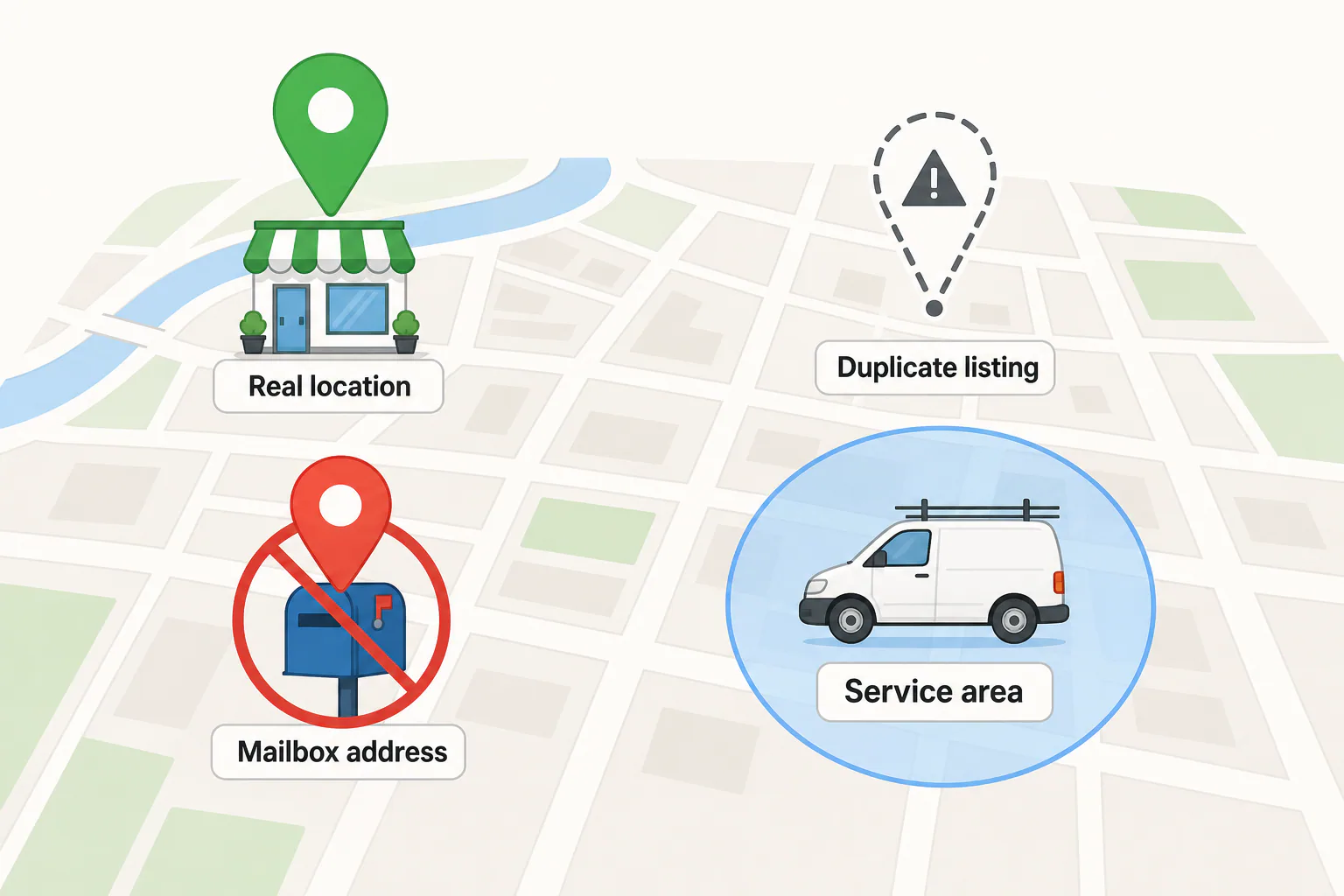
Some agencies create a profile for every town you serve, or list a mailbox store as a “location.” These work for a while, then profiles get suspended, sometimes risking the client’s real profile. Worry when you hear “We’ll get you a listing in every city.”
If you go to your customers and have no storefront, the right setup is a service-area profile that hides your street address. Our Google Business Listing expert service covers setup and optimization of Google Business Listings.
Messy or bought citations
Citations are listings of your business name, address and phone number on sites like Yelp, Bing Places, Apple Maps and trade directories. They help when they match everywhere. Bulk packages that blast your details to hundreds of junk directories leave a mess you’ll clean up for years.
Good practices are boring on purpose: a short list of quality directories, identical details on each, and a spreadsheet copy of every listing. Clear communication and transparency here mean you never guess where your business shows up. Steady quality beats volume.
When a Red Flag Is Not Always a Red Flag
A few practices sound like SEO red flags for a small business but are normal when the terms are fair. The fine print decides, not the practice itself.
Long contracts
SEO is long-term work, so a 6- or 12-month agreement can make sense. What matters is a clear list of monthly work, a way out and every account in your name. No deliverables is the problem.
Setup fees
A one-time fee is normal when it pays for real setup: the audit, technical fixes, Business Profile cleanup and installing tracking. Plenty of honest SEO providers charge one. Ask what it covers, line by line. A vague “onboarding” fee is padding.
Slow early results
Organic SEO starts slow, and that’s normal. Early on you should see work happening. Local San Diego Painting shows what steady effort looks like: with two blog posts a month for over a year, it makes the top 3 in Google listings and gains visibility.
A good digital marketing partner sets these expectations before you sign. Slow is fine. Silent isn’t: months with no visible work, no communication and no explanation are a real red flag, and your visibility suffers.
A Pre-Signing Checklist: Yes or No Questions to Ask the Agency
Ask these on the sales call or by email, and keep the answers. Each has a clear yes or no, with the wanted answer in bold. A wrong answer points straight at one of the SEO red flags a small business should avoid.

Questions about strategy and methods
- Will you audit my website and listings before you send a proposal? Yes
- Can you explain your strategies in plain English, including how you handle link building? Yes
- Do you guarantee a specific position or date? No
- Will anything go live on my site without my approval? No
- If you use AI writing tools, does a person edit and fact-check everything? Yes
Questions about access, ownership and exit
- Will every account be in my name, with your team added as users? Yes
- If I leave, do I keep my content, logins and website files? Yes
- Is there any fee to get my access back? No
- Is there a written exit clause with a set notice period? Yes
Questions about reporting and results
- Do monthly reports show calls, forms and leads, not just traffic? Yes
- Can you set up conversion tracking at the start? Yes
- Do I get one named contact who replies within a business day or two? Yes
- Will you tell me when something isn’t working? Yes
Watch how they answer the last one. Honesty about a slow month is a better sign than a report where every number is green.
What to do if you are already with a bad agency
Don’t cancel in anger first. Protect yourself in this order:
- Get owner or admin access to every account on the list above, before you mention leaving.
- Download past reports, all content and any list of links and citations they built.
- Read the exit clause and send written notice the way the contract asks.
- Get a fresh audit from someone else, so you know what needs fixing.
- Clean up: remove duplicate listings, fix mismatched citations and stop any review schemes.
That fresh look is where we come in. Our Digital Marketing Consulting covers analysis, strategy, link building review and monitoring, and we explain it plainly. Unlike many SEO providers, we keep communication open. Need content? Our blog writing service delivers SEO-optimized posts on a monthly plan.
We won’t promise you a spot on page one. We will show you exactly what we’re doing and what it brings in, so your website gets SEEN without the guesswork. Got a proposal or contract you’re unsure about? Send it our way and we’ll go through it with you.
Frequently Asked Questions
Is it a red flag if an SEO company guarantees first page rankings?
Is it a red flag if an SEO company guarantees first page rankings?
Yes. Nobody outside Google controls where a site lands, so a ranking guarantee is either a sales trick or a plan to rank you for terms that bring no customers. Honest companies don’t offer it. Don’t confuse it with a commitment on work: an agency that lists specific monthly deliverables, with a refund if they miss them, is offering something you can check.
How much should small business SEO cost per month?
How much should small business SEO cost per month?
It depends on how many locations you have, how crowded your trade is locally and how much work your website needs. A single-location business with a focused local plan can start small; our SEO Marketing plan starts at $159 a month. Multi-location businesses and competitive trades need more hours. Get two or three quotes with line items and compare the work, not just the total.
What is black hat SEO and how do I recognize it?
What is black hat SEO and how do I recognize it?
It’s any tactic meant to trick search engines rather than help searchers. Signs on your own site: rankings that jump and then crash, backlinks from foreign or unrelated sites, blog posts stuffed with the same phrase, and pages for places you don’t serve. Ask your agency for a list of the links it built last month. If it won’t share one, that tells you plenty.
Can I leave my SEO agency mid-contract?
Can I leave my SEO agency mid-contract?
Usually, but how depends on the termination clause. Many contracts allow an exit with notice, and a provider that hasn’t delivered the listed work gives you a stronger case. Secure your accounts first, write down missed work with dates, then send notice in writing. For a large contract or a dispute over fees, have a business attorney read it before you act.
Should I hire a local San Diego agency or a remote one?
Should I hire a local San Diego agency or a remote one?
Either can work. A local team knows your neighborhoods, your competitors and how customers here search, which helps with Maps and geomarketing. A remote digital team can do fine work if it truly understands local SEO. The checklist answers matter more than the zip code, so ask every candidate the same questions and pick the partner with the clearest answers.