

Local advertising for small business means getting your name in front of people who live or work near you: free listings, neighborhood apps, paid search and social, print and community work. Start free, then add one paid channel with a budget you set.
Most lists of local marketing tactics name a dozen ideas and never say what to spend or where to start. We’ll give you budget tiers, a rule for picking channels by business type, a way to track results and a 30-day plan you can start next week.
What Local Advertising for Small Business Includes
It covers every way you reach customers inside a set area: your Business Profile and directory listings, Nextdoor, paid search and social campaigns, print, and handshakes at the farmers market. Local marketing for small business is the bigger umbrella, and advertising is the part you pay for.
Advertising vs. marketing vs. local SEO
These three words get mixed up, and the difference changes how you spend money.
- Advertising is paid placement. You pay for a sponsored listing, a spot in search results or a flyer, and the visibility stops the day the payment stops.
- Marketing is everything that makes customers pick you: your brand, your signs, your reviews, your email newsletter, how you answer the phone.
- Local SEO is earning unpaid spots in Maps and search results through your profile, your listings and your website. It builds slowly but keeps working without a monthly media bill.
Picture a plumber in Clairemont who runs a paid search campaign, asks every customer to rate the job and keeps a tidy website. He’s doing all three. The paid campaign brings calls this week; the ratings and the site keep bringing them next year.
Why a clear local audience comes before any ad spend
Every platform asks you to describe your audience, and a vague answer burns money fast. Before you spend a dollar, write down three things:
- Which neighborhoods or ZIP codes your best customers come from. Check your last 20 invoices or receipts.
- Who makes the buying decision: a homeowner, a parent, an office manager, a tourist.
- How far people will travel to you, or how far you’ll drive to them.
A groomer with a storefront in North Park and a mobile groomer covering all of North County need different audiences, different messages and different budgets. Your strategy follows from those three answers, and every channel below gets easier once you have them, whether you serve one neighborhood or several audiences.
How Much Local Advertising Costs: Budget Tiers by Monthly Spend
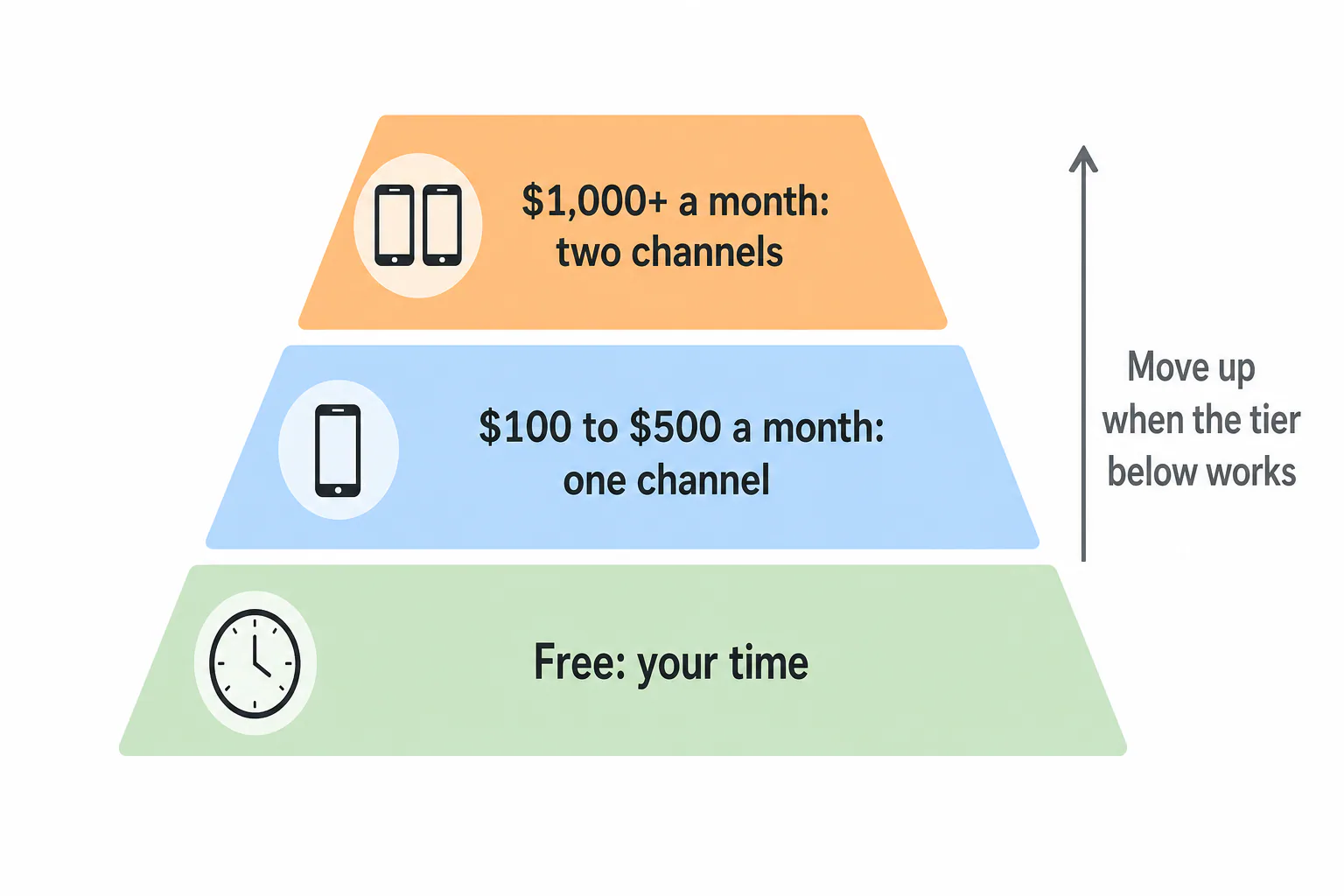
Local advertising for small business can cost nothing beyond your time, or as much as you choose. Search, Facebook and Nextdoor campaigns let you cap spend, so your ad budget is your number. Every local business pays a different cost per click or lead, depending on industry, neighborhood and competitors, and online ads are no exception.
Instead of one price, think in tiers. Each one buys a different kind of visibility.
Free, with only your time
This is where every local business should start. The free tier covers:
- a complete Business Profile;
- consistent directory listings;
- a free Nextdoor business page;
- asking for ratings as a habit;
- one or two community gatherings each month.
The real cost is a few hours a week. Skip this tier and jump to paid platforms, and you risk paying to send people to a half-empty profile.
$100 to $500 a month
This tier buys one paid channel, done properly. Pick a single platform, a tight radius or a few ZIP codes, and one clear offer, then let it run long enough to learn something. A house cleaner might promote a first-clean discount. Spread across four platforms, this budget proves nothing.
$1,000 a month and above
At this level you can run two channels side by side, such as search plus social. You can also retarget people who visited your website, test offers and add occasional print. Many owners hand campaign management to someone else here, since weekly keyword and budget checks become a part-time job.
Costs that catch owners off guard
The platform bill is only part of the cost. Plan for these too:
- Website fixes or a landing page, so paid visitors can call or book on a phone.
- Photos and short videos, since stock images rarely persuade neighbors.
- Your own time, or a manager’s fee, to check results every week.
- Call tracking numbers, so you know which channel rang the phone.
- Design and printing minimums for mailers, plus production costs for billboards on top of the space itself.
- Pay-per-lead charges for wrong numbers or out-of-area callers, which you have to dispute one by one.
Free Local Visibility to Set Up First
Set up the free channels before any paid promotion, because people check them before they call. A paid campaign that sends neighbors to a profile with no photos and wrong hours is marketing money spent on a bad first impression.
Google Business Profile
Your Business Profile is what appears in Google Maps and in the local results, and it’s often the first thing people see. Claim it, verify it, and fill in every field:
- main and secondary categories;
- hours, including holiday hours;
- service area or address, phone and website;
- services with short descriptions;
- at least a dozen real photos of your work, team and storefront.
Then keep the profile alive with a short post every week or two about an offer, a recent job or an upcoming event. Fresh content like this also tells people you’re open and active.
Directories and listing consistency (Yelp, Bing Places, Apple Maps)
Next, claim the big directories:
- Yelp;
- Bing Places;
- Apple Maps, through Apple Business Connect;
- Facebook;
- Nextdoor;
- any trade-specific list, such as Angi, Houzz or the BBB.
What matters most is that your name, address and phone number (often called NAP) read exactly the same everywhere. Consistency makes your brand look established and protects your brand name in search. “Suite 200” on one site and “#200” on another, or an old phone number on a forgotten listing, makes search engines less sure you’re the same business.
A quick checklist: look up your business name plus your old phone number, list every place you show up, and fix or close the mismatches one by one.
Reviews and how to ask for them without gating
Ratings shape whether a neighbor calls you or the next name on the list, so ask every customer, not just the happy ones. Gating means screening customers first: you send only the satisfied ones to your profile and steer unhappy ones to a private form. The platforms’ rules forbid it.
The safe way is to text or email the same link to everyone right after the job. Reply to every rating, good or bad, in a calm and specific way. Yelp discourages asking for feedback at all, so point your requests to your Business Profile and let Yelp ratings come on their own.
Community events and referral partners
In-person trust still travels fast in San Diego. Each of these lets you engage your community face to face and puts a face to your name:
- a booth at the Little Italy Mercato or another farmers market;
- a free workshop at your branch library;
- tables at school fundraisers;
- chamber mixers.
Referral partners work the same way. A realtor sends new homeowners to your handyman service, a yoga studio and a physical therapist recommend each other, a florist and a wedding photographer share clients. Bring a card with a unique code to every event so you can see what it brought in.
Paid Ads for Local Business: Google, Facebook and Instagram
Paid search catches people who are already looking for what you sell; social platforms reach neighbors who aren’t looking yet. That one difference decides which to try first. Urgent needs belong in search, while wants and impulse buys belong in social feeds.
Google Ads and Local Services Ads: when pay-per-lead fits
With Google Ads you bid on searches like “water heater repair La Mesa” and pay when someone clicks. It suits urgent, high-value jobs. You need tight keywords and a list of negative keywords, though, or you’ll pay for clicks from people hunting DIY videos or jobs.
Local Services Ads sit at the very top of results for many trades: plumbers, electricians, cleaners, locksmiths and more. You pass a background and license check, earn a verified badge, and pay per lead instead of per click.
Pay-per-lead fits when three things are true:
- you can answer the phone fast;
- your average job is worth a lot;
- you have the patience to dispute bad leads.
If you’d rather not run any of it yourself, we manage search and social media campaigns as a service.
Facebook and Instagram ads for a small radius
Facebook and Instagram let you show a photo or short video to people inside a radius around your shop, filtered by age or interests. They work best for things consumers buy with their eyes: food, fitness classes, salons, boutiques. Keep the circle small, pick audiences that match your offer, show a real offer, and refresh the content every few weeks to engage them.
Why ad ROI is sometimes low, and what causes it
Plenty of owners try a paid campaign once, see few calls and decide paid promotion doesn’t work. Often the real cause is one of these:
- The radius is too big, so most viewers live too far away to come in.
- The keywords are too broad, or the platform shows your listing to people “interested in” your area instead of people in it.
- Clicks land on a homepage with no clear offer or tap-to-call button.
- Calls go to voicemail during the hours the campaign runs.
- The test ran for one week, too short to tell a dud from a slow start.
- Nobody tracked where customers came from, so a working channel looked like a failure.
Geographic Targeting: Reaching the Right Streets, ZIP Codes and Radius
Geographic targeting tells an online platform where your customers are, so you only pay to reach people who can actually visit or book you. Get it right and a small budget goes much further. Get it wrong and you pay for viewers in Temecula, Tijuana or a hotel room in Chicago, and your web traffic looks busy but never buys.
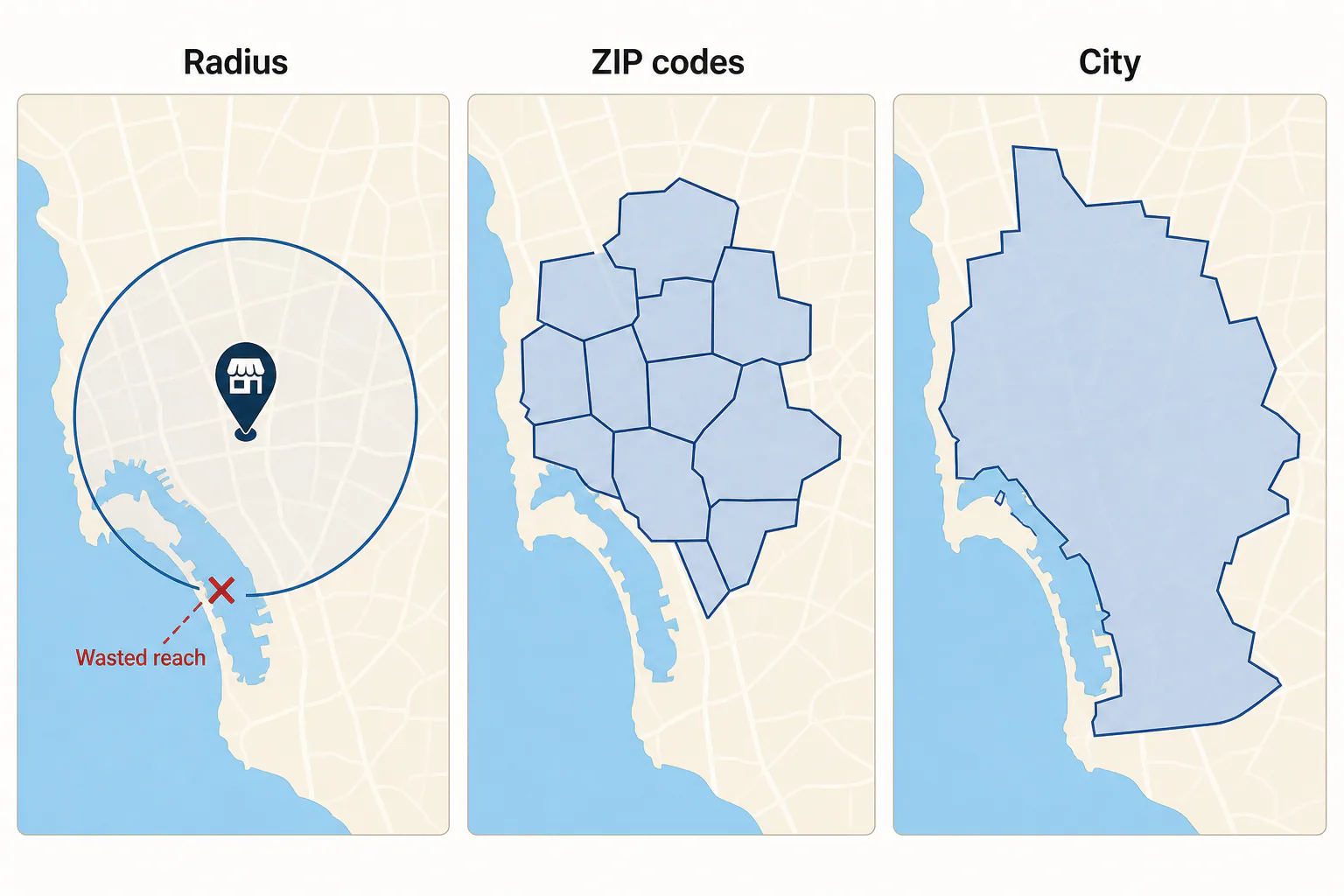
Radius vs. ZIP code vs. city targeting
Each option suits a different kind of business. Here’s how they compare:
| Option | Best for | Watch out for |
|---|---|---|
| Radius (for example, 1-3 miles around your door) | Walk-in shops, cafés, salons, gyms | Circles that cross the bay, freeways and neighborhoods your customers never visit |
| ZIP codes (for example, 92104 North Park, 92116 Normal Heights) | Service trades with a defined service area | Some ZIP codes mix streets you serve with streets you don’t |
| City or county | Movers, online stores with local pickup, businesses serving the whole metro | A small budget spread too thin to engage anyone twice |
Common targeting mistakes that waste budget
The most expensive mistake hides in the location settings. Some platforms default to people “in or interested in” your area, which includes someone in Phoenix planning a vacation. Switch to people who live in or are regularly in your target area. Watch for these leaks too:
- Targeting all of San Diego County when your web leads come from five ZIP codes.
- Drawing a radius around La Jolla that also covers open ocean and campus housing.
- Forgetting to exclude areas you won’t drive to.
- Bidding the same everywhere instead of putting more behind neighborhoods that already buy.
Where geomarketing goes beyond basic targeting
Targeting decides who sees a paid campaign. Geomarketing shapes how your whole online presence speaks to a place: a service-area page for each neighborhood, content that mentions local landmarks and needs, photos from real job sites and local directory listings.
Geomarketing is part of what we do, alongside organic SEO, blog writing and web design. It keeps working when the paid campaign is paused.
Neighborhood Advertising on Nextdoor
Nextdoor reaches verified neighbors grouped by neighborhood, which makes it the closest thing online to word of mouth. People there ask for recommendations by name (“Anyone know a good electrician in Mira Mesa?”). A local business that neighbors recommend gets found without paying for it.
Free business page vs. paid Nextdoor ads
The free business page gives you:
- a profile;
- a place to collect neighbor recommendations;
- ways to engage with people who mention you;
- room to post offers and updates.
The paid option is sponsored posts that show up in neighbors’ news feed. You can aim them at chosen neighborhoods or ZIP codes with a budget you set. Start free, and pay once your page has a few recommendations, since a paid placement that leads to an empty page wastes the click.
Are Nextdoor business pages worth it?
For home services, pet care, tutoring, childcare, restaurants and neighborhood shops, yes: the free page costs only setup and replies. It’s a weaker fit for B2B firms or online-only stores. The downside is that the conversation is public, so a calm, helpful reply matters more there than anywhere else for a local business.
Nextdoor advertising in San Diego
San Diego is a patchwork of distinct neighborhoods, which suits the platform well. A message that says “serving Bay Park and Clairemont” reads local in a way a citywide one never does. Time your offers to the local calendar:
- gutter and roof checks before the winter rains;
- air conditioning tune-ups before late-summer heat;
- window washing after Santa Ana wind season;
- pool openings in spring.
For help planning neighborhood campaigns there, we offer hyper-local marketing and promotions on Nextdoor.
How to stay helpful and avoid spammy posting
Nextdoor is a neighbor space first, and members flag anything that feels like a sales pitch dropped into a conversation. Keep promotions on your business page and in sponsored placements.
When a neighbor asks for a recommendation, reply once and say clearly that you’re the owner. Add something useful, like a quick tip or a rough timeline, instead of just a link. Never ask friends to fake recommendations or flood several threads with the same post. Doing so costs more trust than it earns.

Print, Newsletters and Billboards: When Traditional Media Still Pays
Traditional media still pays when your customers skew older or live in a small area. It also suits consumers who don’t spend much time on social media, but only when you track it. Pick the format that matches how tight your audience is:
- Community and HOA newsletters: cheap, and often read closely in retirement communities and planned neighborhoods.
- Local news sites and community papers: good for restaurants and professional offices that want name recognition.
- Direct mail: USPS Every Door Direct Mail lets you choose mail routes around your shop without buying a list.
- School programs, church bulletins and Little League banners: small cost, real goodwill in the community.
- Billboards and bus benches: high cost, broad reach, hard to track. They fit brands already strong on every other channel.
Whatever you print, add a unique phone number, a QR code to a dedicated page, or a coupon code. Print without tracking is a guess.
Which Local Advertising Channel Fits Your Business Type
The right first channel depends on how consumers find businesses like yours: by searching when they have a problem, by walking past, or by asking neighbors. This table gives you a starting point:
| Business type | Start with | Add next | Leave for later |
|---|---|---|---|
| Service trades | Business Profile, ratings, Local Services or a keyword campaign | Nextdoor | Billboards |
| Retail shops | Business Profile, Instagram and Facebook in a small radius | Community events, partners | Broad keyword campaigns |
| Restaurants and cafes | Profile with menu and photos, Instagram | Nextdoor, local food news | Print display |
| Professional offices | Business Profile, website, ratings | Keyword campaign on high-intent terms, referral partners | Broad social awareness |
Service trades (plumbers, cleaners, electricians)
When a pipe bursts, nobody scrolls Instagram. Consumers type the problem into a search bar and call one of the first few names with strong ratings. Put your effort into three things:
- the profile;
- a steady flow of feedback;
- a pay-per-lead or keyword campaign limited to the ZIP codes you serve.
Nextdoor comes next, since neighbors constantly ask for trusted trades. Before-and-after photos are the content that sells here.
Retail shops
A shop lives on foot traffic and repeat visits. Promote new arrivals to consumers within a mile or two on Instagram and Facebook, and keep your hours accurate everywhere. Team up with nearby shops for a sidewalk sale, join a community market to engage new faces, and collect emails at the register.
Restaurants and cafes
Diners decide with their eyes and their phones. These do more than any flyer:
- fresh food photos on your profile and Instagram;
- a menu that loads fast on a phone;
- quick, friendly replies to feedback.
Nextdoor works well for a “new neighbor” offer. Local food news coverage or a spot at a neighborhood street fair can fill tables on a slow weeknight.
Professional offices and appointment-based businesses
Dentists, accountants, therapists, lawyers and salons win on trust. Clients read reviews and check your website before booking. A tightly targeted campaign on terms like “family dentist Kearny Mesa” can fill calendar gaps and reach new audiences. Referral partners often bring your best long-term clients.
How to Measure Local Ad Results
Measure every channel by actions that lead to money: calls, direction requests, bookings and redemptions. Likes and views don’t count. Set up tracking before you launch, or you’ll be guessing when it’s time to decide what to keep.
Calls, direction requests and form fills
Your Business Profile shows how many people called, asked for directions or clicked to your website each month. Paid platforms report clicks and calls in their dashboards. For phone-heavy businesses, a tracking number per channel shows which one rang. Set every web form to email you, and note the source in a spreadsheet.
Coupon codes and “how did you hear about us” questions
Online numbers miss plenty, because many consumers notice a sponsored message, then look you up by name or walk in days later. Any local business sees this gap. Close it two ways:
- Give each channel its own code, like “NEXTDOOR10” or “MAIL10”, so redemptions tell the story.
- Ask every new customer how they heard about you, and write the answer down. A tally sheet at the counter or a required field on your booking form both work.
Expect answers like “saw your truck” or “a friend on social media” alongside the paid channels.
What a good first-quarter result looks like
No channel comes with guaranteed results. A good first quarter means you know roughly what one new customer costs on each channel. Keep the channels where a new customer costs less than their first purchase plus a few repeat visits, and fix or cut the rest. Look for rising profile calls, direction requests and reviews.
A 30-Day Local Advertising Starter Plan
This plan gets your foundation right first, then runs one small paid test you can actually read. Block two to three hours a week.
Week 1: Fix your profile, listings and website basics
- Complete every field of your Business Profile and add fresh photos.
- Look up your business name and list every directory where you appear. Fix name, address and phone mismatches.
- Check your site on your phone. You need a tap-to-call number, hours, your service area or menu, and a clear next step on the first screen.
- Write down your three target ZIP codes or your radius.
Week 2: Collect reviews and pick one paid channel
Send a review request link to every customer from the last few months, and make asking routine from now on. Use the business-type table above to pick one paid channel and one offer, choose a test budget from your tier, and set up a tracking code or number.
Weeks 3 and 4: Launch a small test and read the numbers
Run the campaign for at least two full weeks without changing everything at once. Check it twice a week: are clicks turning into calls, visits or code redemptions? Look at which neighborhoods and times bring traffic, and pause the parts that only bring views.
At day 30, divide what you spent by the new customers you can trace to the campaign. That number decides your next move: scale up, adjust the offer or try the next channel on your list.
Worked example: a neighborhood bakery
Here’s how the plan could look for an imaginary bakery in South Park. The numbers are made up to show the math.
In week 1 the owner adds morning photos of the pastry case, fixes Sunday hours on Yelp and Apple Maps, and links her menu. In week 2 she prints review cards and picks Nextdoor. Her test is $250 in sponsored posts to South Park, Golden Hill and North Park, offering a free cookie with coffee using the code “NEIGHBOR”.
By day 30, say 25 people redeem the code, about a tenth of her test budget per new customer. If a third start coming in weekly, the test has paid for itself and she raises the budget. If only five redeem it, she changes the offer before blaming the channel.
Where Your Website and SEO Fit Into Local Advertising
Every marketing channel above ends in the same place: someone taps through to your website or profile and decides in seconds whether to call. Paid campaigns rent attention, while organic search and a good site keep earning it. Both belong in the same online strategy.
Why ads send people to a page that has to convert
A paid campaign can bring a neighbor to your page, but the page does the selling. These fixes make it work:
- Match the offer on the web page to the offer in the campaign.
- Put a tap-to-call button and your service area on the first screen.
- Show real photos and testimonials.
- Make the page load fast on a phone.
- Add a simple email signup or booking form, so paid traffic that isn’t ready today doesn’t vanish.
Each fix lowers what you pay per customer on every channel at once, and it helps you show up in organic results too.
Website and SEO plans from Websites San Diego
We design and build websites, then get them seen through organic SEO, geomarketing, blog writing and local promotion. We bring 30 years of experience helping businesses succeed online.
Our monthly marketing plan is priced by the month, with no long setup bill. It covers onsite SEO, geomarketing, Business Profile setup and local directory placement, all with white hat techniques. Local San Diego Painting makes the top 3 in Google listings with 2 blog posts a month. Results vary by business and market.
If you also want posting schedules and content handled, our social media management covers that and helps your brand reach the right audiences. When you’re ready to pick your first channel or fix the page it will point to, that’s the work we do every day.
Frequently Asked Questions
How much does it cost for a small business to advertise?
How much does it cost for a small business to advertise?
Anywhere from nothing to whatever you choose to spend. The free tier costs only time: your profile, listings, ratings, a Nextdoor page and community events. Paid platforms let you set your own cap, so a sensible first test sits in the $100 to $500 a month tier on one channel. Grow from there once you see which one brings customers, and budget for photos, page fixes and management time too.
What is the average cost of advertising for a small business?
What is the average cost of advertising for a small business?
There’s no useful average, because costs vary widely by business. A plumber bidding on emergency jobs in San Diego and a café promoting a weekend brunch pay very different amounts per click or lead. A more useful number is your own cost per new customer: what you spent on a channel divided by the customers you can trace to it. Compare that with what a customer is worth to you over a year.
How do I advertise my business in my local area?
How do I advertise my business in my local area?
Start with a complete Business Profile, matching directory listings and a steady flow of ratings. Then pick one paid channel that fits your type of business: keyword campaigns for urgent services, Instagram and Facebook for shops and food, Nextdoor for neighborhood trades. Aim it at the ZIP codes or radius where your best customers live, and track calls and codes so you know what to keep.
How do I promote my business locally for free?
How do I promote my business locally for free?
Claim and fill out your Business Profile, then list your business on Yelp, Bing Places, Apple Maps and Nextdoor with the same name, address and phone. Ask every customer for a rating, and post useful updates weekly. Show up at a community gathering or two each month, and set up referral swaps with businesses that serve the same customers. It costs time, not cash.
What is the best local advertising for a small business?
What is the best local advertising for a small business?
The best channel is the one consumers in your area already use to find businesses like yours. For most owners that means the free profile and ratings first, since people check them no matter where they first heard your name. After that, service trades tend to start with search; retail and restaurants with Instagram, Facebook and Nextdoor; professional offices with a strong website plus referrals.