

Geomarketing is marketing that uses location data to decide who sees your message, where they see it and when. Instead of advertising to everyone, you aim your marketing campaigns at the people near your shop or inside your service area.
If you’ve been wondering what geomarketing is and whether it’s worth your money, here’s the plain version. We’ll cover how it works, the main tools, some real-world examples and an honest answer on when a small business needs it.
What Is Geomarketing? A Plain-English Definition
Geomarketing is a marketing technique that combines geographic data with demographic data and competitor locations, such as where your customers live, work and travel, to plan your promotions. Knowing your customers locations turns a map into business decisions.
Geomarketing in one sentence
The right message goes to the right people in the right place. A pizza place that sends a lunch coupon only to phones within a mile of the shop is doing geomarketing. The same coupon blasted across the whole county is not.
Why businesses use it: the main benefits
Owners add these strategies for three practical reasons:
- Less wasted spend. You stop paying to reach people who will never drive to you.
- More relevant offers. A regional promotion can match local weather, events or neighborhoods.
- Better insights. Location analysis shows where your best customers actually come from, which helps with decisions like where to put a second shop.
Geomarketing vs. GEO: the Generative Engine Optimization mix-up
Here’s a trap to watch for. In marketing articles, “GEO” now often means Generative Engine Optimization: shaping content so AI tools like ChatGPT mention your business. That has nothing to do with maps. Geomarketing is about physical location, and geo-targeting and geo-fencing are parts of it. Keep that difference between geomarketing and geotargeting in mind when someone pitches you “GEO.”
How Geomarketing Works: Location Data, Analysis and Action
Every setup runs in three stages: collect location information, study it, then act on it.
Where location data comes from: GPS, phones, maps and customer addresses
Location data comes from more places than most owners expect: smartphone GPS, IP addresses, Wi-Fi, cell towers, map apps, satellite imagery, social media and demographic databases. Plain customer addresses from invoices or bookings are free, and a spreadsheet of past jobs is real geographic data.
Turning the data into decisions: catchment areas, footfall and GIS mapping
Next, someone plots the data on a map. Professionals use a geographic information system (GIS); a small shop can use Google Maps pins. Catchment area analysis shows where your customers cluster, and drive-time maps show who can reach you in 10 minutes. Footfall analysis measures foot traffic by time of day.
Delivering the message: ads, offers and local listings
Finally, you act with location-based messages: a search ad in your ZIP codes, a coupon pushed to app users nearby, or a complete Google Business Listing. Good customer engagement means a message that fits where the person is now.
The Main Geomarketing Tools: Geotargeting, Geofencing, Beacons and Local Search
Four types of tools do most of the work, and you don’t need all of them. Each one suits a different marketing strategy and budget.
Geotargeting
Geotargeting (also written geo-targeting) shows promotions only to people in an area you pick: a city, ZIP code or radius. Google Ads, Facebook and Nextdoor offer it. It’s the easiest way into location based targeting, and this kind of geo targeting suits most small budgets.
Geofencing
Geofencing (or geo-fencing) draws a virtual fence around one specific place, like your store, a competitor’s parking lot or a stadium. When a phone crosses that line, it can trigger an ad or an app notification. It’s narrower than geotargeting and only reaches phones with location turned on.
Beacons and in-store signals
Beacons are small Bluetooth devices mounted inside a store. If a shopper has the store’s app and allows it, a beacon can show an aisle offer or log a visit. It’s a technique mostly for bigger retailers. For a single shop, it’s usually overkill.
Location analytics and local SEO
Location analytics tells you where your audience is. Google Analytics reports visitors by city, and your Google Business Listing shows where direction requests come from. It’s the free side of local marketing: a complete listing, consistent address details and schema markup so you show up in Maps.
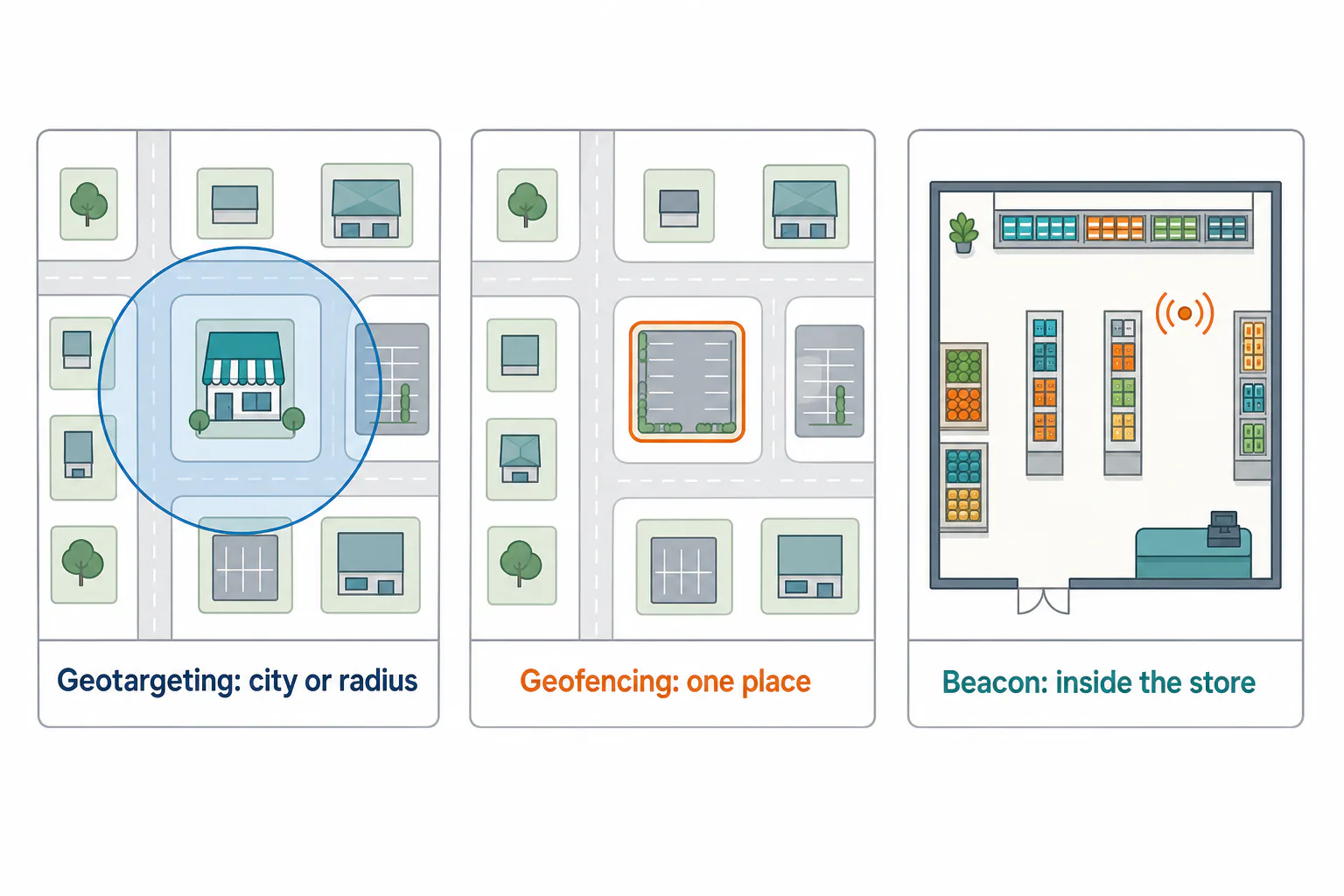
Geomarketing vs. Geotargeting, Geofencing and Geographic Segmentation
These terms get mixed up constantly, even by marketers. Geomarketing is the umbrella, and the other three sit under it. Targeting decides who sees an ad; geomarketing also covers the planning before and after.
A quick comparison table of the four terms
Here’s how the four compare on what each one is, its scale and a small-business example.
| Term | What it is | Scale | Small-business example |
|---|---|---|---|
| Geomarketing | The whole approach of using location in marketing | Any | Deciding where to advertise and what to offer each area |
| Geotargeting | Showing ads to people inside a chosen area | City, ZIP code, radius | A roofer running search ads in three ZIP codes |
| Geofencing | Triggering a message when a phone enters a set boundary | One building or block | A gym pinging app users who walk past |
| Geographic segmentation | Splitting your audience into groups by where they are | Region, climate, city vs. suburb | A landscaper sending different spring offers to coastal and inland clients |
What geographic segmentation means in marketing
This one is planning, not delivery. You sort customers by location (region, city, neighborhood, climate) and treat each group differently. It shapes location based campaigns before anything goes live: inland homes may need AC service weeks before coastal ones.
Which example is geofencing marketing?
Picture a car wash with its own app. It sets a fence around its lot and the road out front. When a member drives inside, the app offers a free tire shine for the next hour. That’s geo fencing: the trigger is someone physically entering a place. The same offer shown to everyone in town would be geotargeting.
Geomarketing Examples: A Coffee Shop, a Plumber and a Retail Chain
These examples are illustrative setups, not client case studies. A coffee shop near offices might run mobile marketing campaigns within half a mile from 7 to 10 a.m. on weekdays, when consumers walk past. It’s simple, cheap and tied to real behavior of local consumers.
A worked example for one local business, from data to result
Here’s how a plumber could build a campaign from scratch:
- Pull the data. Export the addresses of last year’s jobs from the invoicing software.
- Map them. Drop them into Google My Maps. Say most jobs cluster in four ZIP codes, with a gap in a growing neighborhood next door.
- Decide. Keep the listing and service pages strong for the four core ZIP codes, and run geotargeted search ads only in the gap neighborhood.
- Tailor the offer. Promote a “new homeowner” water heater check for the newer houses there.
- Measure. Put a call-tracking number on that campaign and compare calls with the months before.
Nothing here is magic. The point is that every dollar now goes to a place chosen from your own data instead of a guess.

How chains use it for site selection and market expansion
Chains lean on geomarketing before a store opens. They layer census data, competitor locations and traffic counts to select sites. After opening, they use it for regional campaigns, logistics and supply-chain routing, and competitor analysis, and they track foot traffic to see what works. The software costs more, but the logic matches the plumber’s map.
Is Geomarketing Worth It for a Small Business? A Decision Rule
Our rule is simple: get found first, then add targeting. If people already search for what you do, a strong website and Google Business Listing come before any paid strategies. Spend on ads once that foundation works and you want more customers from specific areas.
When plain local SEO is enough
If you serve a small area, people search when they need you and you already show up in Google Maps, organic SEO and a well-kept listing may be enough. Local San Diego Painting makes the top 3 in Google listings with 2 blog posts per month for over a year.
When to add geotargeted ads or geofencing
Add geotargeted campaigns for a new area, a seasonal offer, or bigger names crowding the Maps results. Geofencing fits an app or a spot with heavy foot traffic. If your audience doesn’t search for you yet, location based promotions reach them earlier.
Privacy, consent and accuracy limits to know about
Location data is personal. Many users refuse to share location, so a geofenced audience is smaller than the map suggests. California’s privacy law treats precise geolocation as sensitive personal information, so use reputable platforms and never buy sketchy location lists. GPS drifts indoors, and IP-based targeting can misplace someone. Judge campaigns by calls and visits.
A simple geomarketing strategy to start with
- Fix your Google Business Listing and the location details on your website.
- Map your customers’ locations from invoices or bookings.
- Select one or two areas you want to grow in.
- Run one small geotargeted campaign there with a clear offer.
- Check calls, form fills and visits every month, then adjust.
That gives you a marketing strategy based on real customer behavior, not hunches, and it fits a small local marketing budget. If you’d rather hand off the setup, our SEO Marketing plan covers onsite SEO and geomarketing, Google Business setup and maintenance, and placement in local directories, billed monthly.
Frequently Asked Questions
What does geotargeting do?
What does geotargeting do?
Geotargeting limits who sees your ads or content to people in a location you choose, such as a city, a ZIP code or a radius around your business. The platform works this out from GPS, the IP address or the location in a user’s profile. For a local business, it means you stop paying for clicks from people hundreds of miles away.
What is geographical segmentation in marketing?
What is geographical segmentation in marketing?
It means dividing a market into groups by where people are: state, city, neighborhood, climate, or urban versus rural. Each group gets products, messages or prices that suit it. A San Diego pool company, for example, might push heaters to inland homes in winter and focus on weekly cleaning near the coast.
What are the four types of target market?
What are the four types of target market?
The four classic ways to define a target market are geographic (where people live), demographic (age, income, family), psychographic (values, lifestyle) and behavioral (buying behavior and habits). Most small businesses combine them, for example homeowners within five miles who have hired a contractor before.
Is geomarketing the same as local SEO?
Is geomarketing the same as local SEO?
No. Showing up in nearby Google and Maps searches is one part of it. Geomarketing also includes paid location ads, geofencing, mapping where your customers come from, and choices like where to open or advertise. You can rank well in Maps without ever running a single location ad.
Do I need special software to try geomarketing?
Do I need special software to try geomarketing?
Not to start. Google My Maps, Google Analytics, your Google Business Listing insights and the location settings in Google Ads or Facebook cover most of what a small business needs. Dedicated GIS and geofencing platforms are built for chains and agencies, and they usually cost more than a single shop needs to spend.