

The best way to respond to negative reviews is simple. Wait until you’re calm, answer within a day or two, thank the person, apologize without excuses, and offer to fix it offline. A bad one stings, but your response is for the next hundred customers who read it.
Not every one-star rating gets the same treatment. Some need a public answer, some need a private fix, and some should be flagged. Here’s how to tell them apart, plus wording you can copy today.
Respond, Message, Flag or Ignore: A Decision Rule for Every Complaint
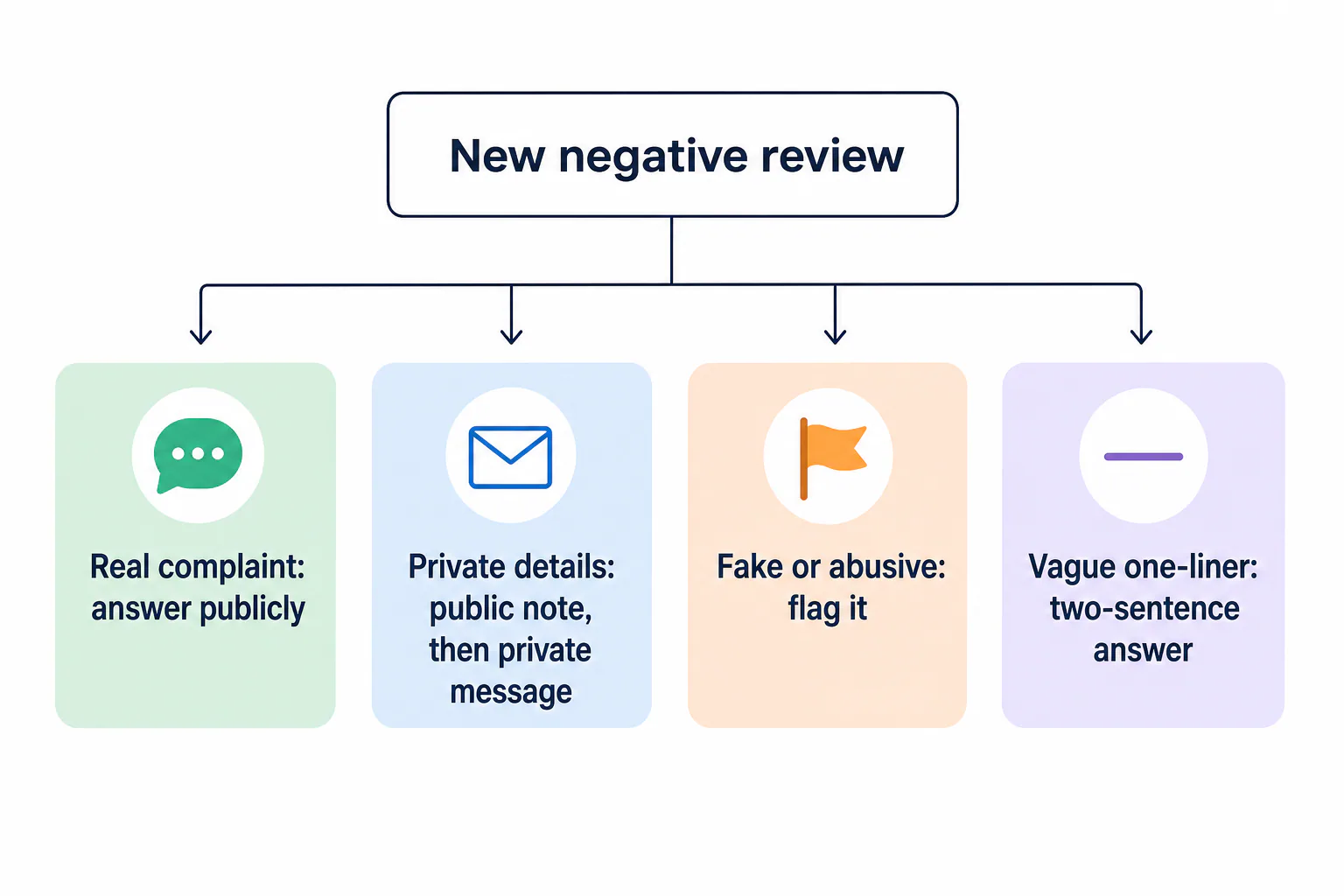
Should you respond to negative reviews? Almost always, yes. Silence tells everyone scrolling your profile that nobody’s home. What changes is the move, and this rule covers it: Replies only help if people can find you, so if customers say they can’t, check why your business isn’t showing up on Google Maps first.
- Real complaint from a real customer: respond publicly.
- The fix needs order numbers, addresses or a long conversation: post a short public note, then go private.
- Fake, off-topic or abusive: flag it.
- Vague one-liner: give a two-sentence answer.
Ignoring a post is only right for obvious spam you’ve already reported.
When a public response is the right move
Answer in public whenever a genuine customer describes something that really took place, even if you remember it differently. That answer is really for potential customers, who judge you by how you handle negative feedback online. A calm, specific response protects your online reputation better than an argument.
When to take it to a private message
Go private when the fix involves details nobody should post: account numbers, health information, an address or billing back-and-forth. Yelp lets you send a direct message. On Google you’ll need a phone number or email. Post a one-line public note on the online review first.
When to flag a fake or rule-breaking post instead
Flag posts from non-customers, posts meant for another business, hate speech, threats and anything sharing personal information. Don’t argue while you wait. If it stays up, use one neutral line: “We can’t find a record of your visit. Please call us.”
When a vague or one-line comment needs only a short answer
“Worst place ever” gives you nothing to fix, so don’t write an essay. Acknowledge the feedback, say you’d like to hear more, and give a way to reach you. Two sentences is plenty. Like other bad reviews, a long defense under a short comment looks defensive.
How to Respond to Negative Reviews in 5 Steps
Here’s the short version of how to respond to negative reviews, in order:
- Pause and read the review twice.
- Respond within one to two days.
- Thank the customer and name the problem.
- Apologize for the experience, with no excuses.
- Offer a next step and move the details offline.
Step 1: Pause and read the review twice before you type
Your first draft will probably be defensive. That’s normal. Read the review once for the facts and once for what the customer wants: a refund, an apology or simply to be heard. Check your records and talk to whoever was involved.
Step 2: Respond within one to two days
Respond quickly, but not in the heat of the moment. A day or two lets you check the facts while the customer still cares. To make that window realistic, check every platform regularly and turn on alerts, so a new Google review never sits unseen. An answer three weeks late reads like you only noticed because your star rating dropped.
Step 3: Thank the reviewer and acknowledge the problem
Thank them for the feedback, then name the actual problem: “Thanks for telling us about the long wait during Saturday’s lunch rush.” Naming the issue proves a person read it. Skip “We value your feedback.” It sounds copied.
Step 4: Apologize for the experience without making excuses
Apologize for how the visit felt, and skip the story about being short-staffed. Even true excuses sound like blame-shifting in public. “We’re sorry your visit wasn’t what you expected” does the job. If mistakes on your end caused it, say what you’re changing, and learn from those mistakes.
Step 5: Offer a next step and take the details offline
Give one name and one way to reach you: “Please call Maria at [phone] and she’ll sort this out.” That’s where real customer service happens, and good customer service after a bad experience can turn an angry reviewer into a loyal regular and improve the whole customer experience.
A Before-and-After Example: From Defensive Reply to Calm Answer
Here’s an illustrative example for a local heating and air company, run through the five steps.
The review as it was posted
“Booked a 9am AC tune-up. Tech showed up at 11:30, no call, no text. Then I got charged the full fee for a 20-minute visit. Never again. 1 star.”
The first draft most owners write, and why it hurts
“That’s not what happened. Our tech was stuck in traffic on the 805, and our pricing is right on our website. Maybe read it next time.”
Every word of that might be true, and it still loses. It argues, blames traffic and ends in sarcasm. Readers only see an owner picking a fight, which hurts your online reputation more than the one-star review did.
The rewrite, line by line
- “Hi Dan, thanks for letting us know about Tuesday’s appointment.” Uses his name and points to the specific visit.
- “You expected us at 9, we arrived at 11:30, and nobody called. We’re sorry. That’s not how we want anyone’s morning to go.” Restates his facts without arguing and apologizes for the service, not the traffic.
- “We now text customers when a tech is running more than 30 minutes behind.” Shows a change. Only include a line like this if it’s true.
- “I’d like to go over the charge with you. Please call me directly at [phone]. Mike, owner.” Moves the money talk offline where you can resolve it, and it’s signed by a real person.
Same facts, opposite effect. The calm version gives readers a positive reason to book anyway, and good online reputation management starts with answers like it.
How to Apologize Without Admitting Legal Liability
Apologize for the experience, not for causing harm, and talk about what you’ll do next instead of who was at fault. This is general guidance, not legal advice.
Phrases that show care and stay safe
These show you care without accepting blame:
- “We’re sorry your visit didn’t go the way you hoped.”
- “Sorry to hear about this. Our team is looking into it.”
- “Thank you for raising this with us.”
- “We’d like to talk with you directly so we understand the full picture.”
Phrases to avoid
- “It was our fault.”
- “Our employee messed up.”
- “We’ll pay for the damage.”
- “This has happened before.”
Also skip guessing at causes in public, and never blame an individual employee. Admitting mistakes in detail before you know the facts can come back to bite you later.
When to talk to a lawyer or your insurer first
If a review mentions an injury, property damage, food poisoning, discrimination or a threat to sue, hold off on answering and call your lawyer or insurer first. Your policy may limit what you can say. Publicly, “We take this seriously and are looking into it” is enough.

Response Templates by Scenario and Platform
These examples show how to respond to negative reviews by scenario. Swap in your own details, because a review response that sounds copied is almost as bad as silence. They fit most online posts on a rating site.
Slow service or long wait
“Hi [Name], we’re sorry about the wait on [day]. Our service was slower than we want it to be, and we’re adjusting staffing for that shift. Next time, ask for [manager] and we’ll look after you.”
Poor quality or a wrong result
“Hi [Name], we’re sorry the [job or item] didn’t turn out right. We’d like to see it and fix it. Please call [Name] at [phone] so we can set a time.”
A pricing or billing complaint
“Hi [Name], we appreciate you raising this, and we’re sorry the bill wasn’t what you expected. We’d like to go over it with you line by line. Please call [phone] or email [address].”
Never post amounts or account details in public.
Google Business Profile and Yelp: public response rules
On Google Business Profile, you answer from your profile, the response appears under the review, and you can edit it later. You can’t remove a Google post yourself, only report it if it breaks policy. Yelp allows a public comment, a private message, or both. Reviewers judge you against what your listing promises, so choosing accurate business categories helps set the right expectations from the start.
Facebook reviews and Marketplace: what is different
On a Facebook Page, reviews show up as recommendations you can comment under, so the five steps apply. Marketplace works differently: there’s usually no public thread, so you resolve it in Messenger with the buyer and keep the conversation for your records. Treat a Google review the same way: stay calm and keep it factual.
Trustpilot: responding and the invite-to-update options
Trustpilot lets you respond publicly to any review, and the author is notified. Once you’ve solved the problem, you can ask them to take another look and update it. Ask once, politely, and leave the choice to them. Pushing for a higher rating can break the rules.
A short follow-up email or private message
If you’re wondering how to respond to negative reviews by email, send this after your public answer, using an address from your records or the platform’s messaging:
“Hi Dan, this is Mike from [Business]. I saw your review about Tuesday, and I’m sorry we let you down. I’d like to make it right. Can I call you today or tomorrow? My direct line is [phone]. Mike”
This works for most complaints because it’s short, personal and asks one easy question.
When the Private Fix Fails: Reviewers Who Will Not Update, and Reviews You Cannot Delete
Some negative reviews stay up no matter how well you handle them. That’s normal, and handling them well still pays off.
What to do if the reviewer ignores you or stays angry
You can’t make anyone change a review, so don’t chase. Send one follow-up after about a week, then stop, and say they’re welcome back anytime. Your public response shows potential customers you tried.

Can I delete a negative review? What you can and cannot do
No. On Google, Yelp, Facebook and Trustpilot, a business can’t delete a customer’s online review. You can report one that breaks the rules, and the platform decides. Offering a refund or discount to remove or change a post breaks most platforms’ rules.
Burying one bad review with honest new ones
The honest fix for a bad review is more good ones. Ask happy customers at checkout, on a receipt or by text, and never buy them. Consumers read the pattern: one rough night among positive ones looks like a bad night, not a bad business. A steady flow of reviews and thoughtful replies also supports how your business ranks on Google Maps for nearby searches.
Start today. Answer that one-star review using the five steps, then set a weekly reminder to check your profiles. If you’d rather have help keeping your listing active, our SEO Marketing plan includes Google Business setup and maintenance plus placement in local directories. While you’re in there, regular Google Business Profile posts give people reading your reviews fresh reasons to choose you.
Frequently Asked Questions
Should I respond to every negative review?
Should I respond to every negative review?
Answer every negative review that comes from a real customer, even the short ones. Flag fake or abusive reviews instead of arguing with them. It’s also worth answering people who leave positive reviews. A profile where the owner responds to everyone makes your answers to complaints look like normal attention, not damage control.
How do I respond to a negative review on Facebook Marketplace?
How do I respond to a negative review on Facebook Marketplace?
Marketplace ratings usually don’t come with a public thread you can answer. Open Messenger, contact the buyer, acknowledge the problem, and offer a fair fix such as a return or a partial refund. Keep it polite and save the chat. If the complaints land on your business Page instead, comment publicly using the same five steps.
Can you give some examples of how to respond to customer complaints?
Can you give some examples of how to respond to customer complaints?
Three short ones cover most situations. “We’re sorry about the wait on Friday, and we’re adjusting that shift.” “We’re sorry the repair didn’t hold. Please call [Name] at [phone] and we’ll come back out.” “We’d like to go through the bill with you. Please give us a call.” You’ll find fuller versions by scenario in the templates above.
How long should a review reply be?
How long should a review reply be?
A good review response runs two to five sentences. That’s long enough to acknowledge the problem, apologize and give a next step, and short enough that someone scrolling on a phone reads all of it. Match the review: a one-line complaint gets a short answer, and a detailed story deserves a specific one.
Do replies to negative reviews help my Google Maps ranking?
Do replies to negative reviews help my Google Maps ranking?
Nobody outside Google can promise a ranking boost from your answers, so be wary of anyone who does. What’s clear is that reviews shape how your profile looks to searchers, and a calm answer under a complaint makes people more comfortable calling you. Think of responses as a way to win the customer, not a ranking trick.