

Pick a website builder like Wix or Squarespace if you need a simple site fast and your budget is tight. Go custom when your website has to win customers from Google or handle features a template can’t.
That’s the short version of the website builder vs custom website question. Most comparisons stop at “builders are cheap, custom is flexible.” Below, we add a three-year cost view you can fill in with your own quotes and a decision rule you can answer in a few minutes.
The Short Answer: Choose a Builder or Go Custom
Is it better to use a website builder or a custom website? A builder is usually better for a small, simple site you’ll run yourself. A custom website is better once your site is a main source of new customers. The details decide it.
Choose a website builder if…
- You need a basic site (home, services, about, contact) and you need it soon.
- You’re comfortable typing text and dragging photos into a page editor.
- Most of your customers come from referrals, so the site mainly confirms you’re real.
- You’d rather pay a predictable monthly subscription than a large upfront fee.
Choose a custom website if…
- You want to rank in Google and Google Maps for searches across your service area.
- You need features such as quote calculators, booking rules or several locations.
- Your brand has to look unlike every competitor using the same template.
- You don’t want to spend your evenings maintaining a website.
Side-by-side table: cost, launch time, skill, flexibility, maintenance and SEO
This table compares the two options on the six points that usually settle the choice.
| Factor | Website builder | Custom website |
|---|---|---|
| Cost | Low upfront, monthly subscription plus paid apps | Higher upfront build fee, then hosting and maintenance |
| Launch time | As fast as you can write your pages | Weeks of design, build and review rounds |
| Skill needed | Basic computer skills | A web developer or agency does the build |
| Flexibility | Limited to what the template and apps allow | Built around your business and features |
| Maintenance | Platform handles hosting and updates | Developer, retainer or managed plan |
| SEO | Solid basics, limited technical control | Full control over speed and structure |
What Each Option Really Is
A builder is software you rent. A custom website is a site someone builds for you, on a platform you can usually take with you.
Website builders: Wix, Squarespace and similar drag-and-drop platforms
Wix and Squarespace give you templates, a drag-and-drop editor, hosting and security in one account. You pick a design, swap in your text and photos, and publish. Everything lives on their servers, under their rules.
Custom websites: WordPress builds, Webflow and hand-coded sites
A custom site is designed for your business by a web developer or web agency. Most are built on WordPress, the open-source system you can host anywhere. Others use Webflow, a visual tool for designers, or are hand-coded from scratch. Your pages are planned around your services and customers, not a template’s layout.
Why the line between them is blurrier than vendors admit
Webflow is technically a hosted platform, yet designers use it for fully custom work. Many agencies build WordPress sites with page-builder tools that feel like Wix inside. Some, including us, sell custom sites on a monthly plan with hosting and maintenance bundled. So the real question is who designs the site, who keeps it running and whether you can move it later.
Cost Over Three Years, Not Just Month One
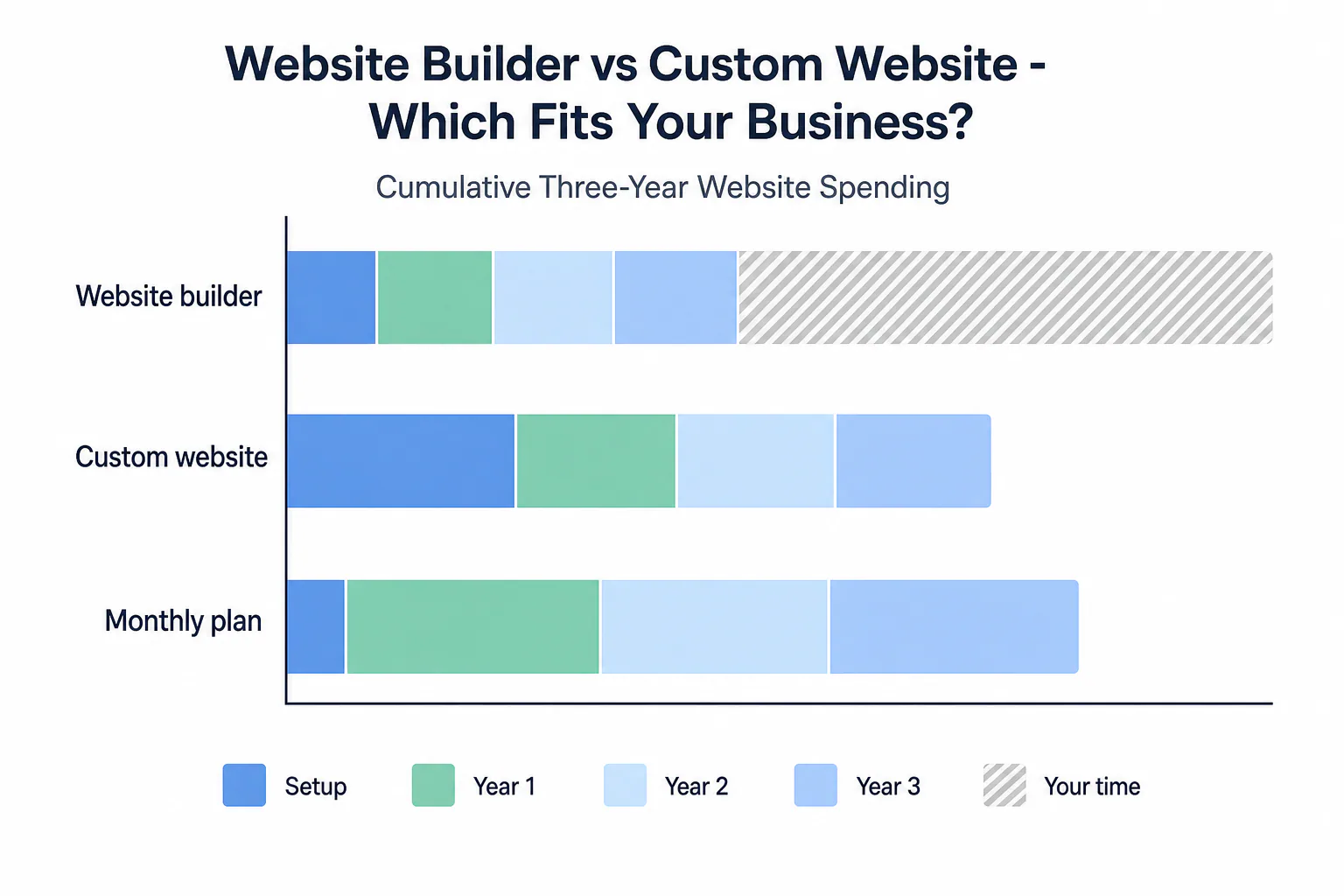
Website builder vs custom website cost only makes sense over several years. If you wonder how much does a small business website cost, the honest answer is the three-year total, not the month-one price. A low monthly fee adds up, and a custom build’s upfront price spreads out.
What you pay for with a builder: subscription, apps, templates and add-ons
With a builder, you pay for the plan, and higher tiers unlock e-commerce or more storage. You also pay for apps for bookings, forms or reviews, sometimes a premium template, and a business email inbox. Count payment fees if you sell. Apps are the line people forget: a site with five of them costs far more than the advertised plan price.
What you pay for with a custom site: design, development, hosting and maintenance
A custom site costs more upfront for design and website development. On top of that come the domain name, hosting, any premium plugin licenses and a maintenance retainer for updates, backups and fixes.
A worked three-year example with placeholder numbers you can swap for your quotes
Fill this in with your real quotes. The third column uses our own starting price as an example.
| Line item | Builder | Custom build | Monthly agency plan |
|---|---|---|---|
| Setup (month one) | Template $____ | Build fee $____ | Included |
| Monthly fees × 36 | Plan $____ × 36 | Hosting $____ × 36 | $99 × 36 = $3,564 |
| Add-ons × 36 | Apps $____ × 36 | Retainer $____ × 36 | Upgrades, if any |
| Your time × 36 | Hours × your hourly rate | Minimal | Minimal |
| Three-year total | $____ | $____ | From $3,564 |
Our Website Development plan starts at $99 a month and includes the domain name, managed hosting, maintenance and support. Don’t skip the “your time” row. Two hours a month of fiddling with a builder, at what your time is worth, can outweigh the subscription.
Sales tax, freelancer rates and other US details to check in a quote
Sales tax on web design, hosting and software subscriptions differs by state. Ask whether a quote includes tax, and check with your accountant. Freelancers may bill hourly or by project, so ask for the rate, the estimated hours and the price of changes after launch. Confirm the domain is registered in your name and you get the design files. Before you contact any developer, check what to prepare for small business web design so every quote covers the same scope.
Design, SEO and Speed: Where a Builder Holds Up and Where It Stops
A modern builder covers the basics well. It hits limits once you need a unique look, a large site or serious speed tuning.
Template limits and brand look
You can change colors, fonts and photos, but the layout bones stay the same. Popular templates show up on many sites, maybe a competitor’s down the street. That’s fine for a bakery with hours and a menu. For a contractor competing on trust, looking generic costs calls.
What a modern builder already handles for SEO
Wix and Squarespace let you edit page titles and meta descriptions, and they handle HTTPS, mobile layouts, clean URLs and sitemaps. The claim that builder sites can’t rank is outdated. With good content and an optimized Google Business Listing, a builder site can show up in local results.
When technical SEO and Core Web Vitals need custom work
Core Web Vitals measure loading speed, layout stability and responsiveness. Every app you add to a builder loads more scripts, and you can’t strip out the platform’s code. A custom build lets a developer trim that weight, add structured data and plan a page for every service and neighborhood, which helps SEO for small business. But a sloppy custom site can lose to a well-configured builder site.
Time, Skills and Upkeep: Who Does the Work
A builder trades money for your time. A custom site trades your time for someone else’s.
How fast each option gets you online
A builder site can go live as soon as your words and photos are ready, and that content is usually the real bottleneck. A custom build adds discovery, design approval, development and testing. Expect weeks rather than days, and have your content ready early so the timeline doesn’t slip.
What you must be able to do yourself
On a builder, these jobs are yours:
- Writing every page so it sounds like you and answers what customers ask
- Taking or choosing sharp photos and sizing them so pages load fast
- Updating hours, prices and services when they change
- Connecting your domain, email and Google Business Listing
Hosting, security and updates after launch
Builders bundle hosting, security and updates into the subscription. A self-hosted WordPress site needs regular plugin updates, backups and security monitoring, or it slowly breaks. For website hosting and maintenance for small business, most owners lean on a retainer or managed plan. Ours includes both.
The Downsides of Builders at Scale: Lock-In, Exports and Migration
A builder is easy to join and hard to leave. Vendor pages rarely spell that out.
Who owns your site and your content
You own your text, photos and domain. The design, the code and the way the pages are put together belong to the platform. Most builders let you export some content, such as blog posts or product lists, but not the site itself. Stop paying, and the site goes offline.
Signs you have outgrown your builder
- You pay for several apps to patch features the platform lacks.
- Pages feel slow on a phone, and app scripts are the reason.
- You want separate pages for each city or service, and managing them is painful.
- A feature you need, like custom quoting, simply isn’t possible.
Starting on a builder and moving to custom later
Starting small and moving later works if you plan for it, and it keeps scalability open as you add locations or services. Do this early:
- Register your domain with a registrar you control, not inside the builder.
- Keep copies of all text and images.
- When you move, list every old URL.
- Set up 301 redirects to the matching new pages, so Google passes your rankings to the new site.

A Simple Decision Rule for Your Website Builder vs Custom Website Choice
Answer four questions honestly, and the website builder vs custom website choice usually makes itself.
Four questions on budget, page count, growth plans and features
- Budget: Which column in the three-year table above is lowest once you count your own time?
- Page count: Do you need only the basic four pages? Or do you need a page for every service and area you cover?
- Growth: Do you plan to add locations, staff or products in the next few years? Scalability matters here: a site that grows with you differs from one that hits platform limits.
- Features: Do you need anything beyond a contact form and standard booking?
If you answered “basic” and “no” to the last three, use a builder. Two or more answers pointing toward growth or custom features mean a custom site will cost less in frustration and rebuilds.
Verdicts for a service business, a store and a business that depends on local search
Referral-based service business (a solo bookkeeper): a builder is fine. Online store: a builder’s e-commerce plan works for a modest catalog, but go custom once inventory, shipping rules or app costs get complicated. Business that lives on local search (plumbers, painters, dentists): go custom or choose a managed plan built for SEO. On our Google Business page, we point out that most of these searches are done on Google Maps.
Getting Your Site Built: Where Websites San Diego Can Help
We build custom websites on a monthly plan, so you skip both the big upfront fee and the do-it-yourself evenings.
What a website development plan starting at $99/mo covers
Our Website Development plan starts at $99 a month. It covers sites that work on phones and large monitors, plus your domain name, managed hosting, and ongoing maintenance and support. We handle design, development and the SEO campaign in plain language, backed by 30 years of helping businesses succeed online.
How to add SEO and blog content later
Once the site is live, our SEO Marketing service covers onsite SEO and geomarketing, Google Business setup and maintenance, and local directory placement, all with white hat techniques. Local San Diego Painting consistently makes the top 3 in the Google listings, with 2 blog posts per month for over a year. We don’t promise rankings. Need listing help first? Our Google Business Listing experts handle it, and digital marketing consulting starts with an analysis of your business. Bring your three-year table.
Frequently Asked Questions
Is $1,500 a good price for a website?
Is $1,500 a good price for a website?
It depends entirely on what’s included. Ask how many pages you get, whether the text is written for you, and how many design revisions are included. Also check whether SEO basics, hosting and maintenance are covered, and who owns the domain and files. A low price that leaves out copywriting and upkeep can end up costing more than a pricier quote that covers them.
Is WordPress outdated in 2026?
Is WordPress outdated in 2026?
No. WordPress is still widely used, actively maintained and open source, so you can host it anywhere and hire any developer to work on it. Its weak spot is upkeep rather than age: plugins and the core software need regular updates. That’s why many owners run it through a managed hosting plan or a maintenance retainer.
Can a website built on a builder rank on Google?
Can a website built on a builder rank on Google?
Yes. Modern builders handle page titles, mobile layouts, HTTPS and sitemaps, so a builder site with helpful content and a strong Google Business Listing can rank locally. The limits appear in competitive markets, where page speed, site structure and many location or service pages make the difference. Those are easier to control on a custom build.
Do I own my website if I use a website builder?
Do I own my website if I use a website builder?
You own your content and your domain, but you’re renting the design and the platform. Most builders don’t let you move the full site to another host, and the site goes offline if you cancel. Register your domain separately, keep backups of your text and photos, and you’ll keep the parts that matter most.
How much does a custom website cost compared to a website builder?
How much does a custom website cost compared to a website builder?
A custom site usually costs more upfront, while a builder costs more in monthly add-ons and your own time. Compare them over three years with the worksheet above rather than month one alone. Monthly plans sit in between: ours starts at $99 a month with domain, hosting and maintenance included.