

Local SEO is the part of organic work that gets you found by people near you, mostly in Google Maps and the map box at the top of the results. Organic search in the wider sense ranks your website in the regular unpaid results for anyone, anywhere. So the real question in local SEO vs organic SEO is how far from your front door your customers live.
If they live within a short drive, start with the map. If they could be anywhere in the country, start with your website’s content. Most small businesses end up needing a bit of both, and we’ll show you how to split a small budget between them.
The Short Answer: Local SEO vs Organic SEO in Plain Words
The difference between local SEO and organic SEO is reach. Local work helps a business show up for searches tied to a place, like “plumber near me,” mostly in the Google Map Pack. Organic work ranks any website in the regular unpaid results for a broader, often national audience, based on content, keywords and authority.
Local SEO is a part of organic SEO, not its opposite
Agencies often pitch these as two separate products, and that’s where the confusion starts. All unpaid search work is organic. The map version adds location signals: your address, service area, Google Business Profile and reviews. The foundation is the same, so a slow, thin website hurts you everywhere. When people set “organic” against “local,” they usually mean national SEO: ranking for searches with no place attached.
The one-line difference: who you want to reach and where
Nearby work reaches people who want something close, often today, using location specific queries like a service plus a city. National SEO reaches people researching a topic or product wherever they are, and national SEO takes a different route from a specific location focus. A dentist in Chula Vista needs the first. A company selling dental night guards nationwide needs the second. Search engines read this from the words people type.
Where paid ads fit in (SEO vs pay per click)
Pay per click (PPC) is the third option, and it isn’t SEO at all. With Google Ads you pay each time someone clicks, and the traffic stops the day you stop paying. Organic work earns the unpaid spots and builds authority. It takes longer, but keeps working after the work is done. If someone offers “paid SEO,” ask what the money buys: ads, or work on your website and listing. A good SEO strategy starts with that answer.
Local SEO vs Organic SEO Side by Side
In local SEO vs organic SEO, the two approaches chase different searchers, show up in different parts of the page and get judged by different numbers.
Comparison table: audience, where you appear, what you work on, how you measure
Here’s how the two compare on the points that matter when you’re deciding where to spend:
| Local SEO | Organic (national) SEO | |
|---|---|---|
| Who it reaches | People searching in or near a specific location | People searching a topic or product from anywhere |
| Where you appear | Map Pack (local 3-pack), Google Maps, plus the regular results | The regular blue-link search results |
| What you work on | Your Google listing, reviews, citations, location pages | Content, keywords, technical health, backlinks |
| What drives rankings | Relevance, distance from the searcher, prominence | Relevant content, site quality, authority from links |
| How you measure | Calls, direction requests, listing views, map position | Organic traffic, keyword positions, leads or sales from the site |
| Who it suits | Storefronts and service-area businesses | Online stores and national service providers |
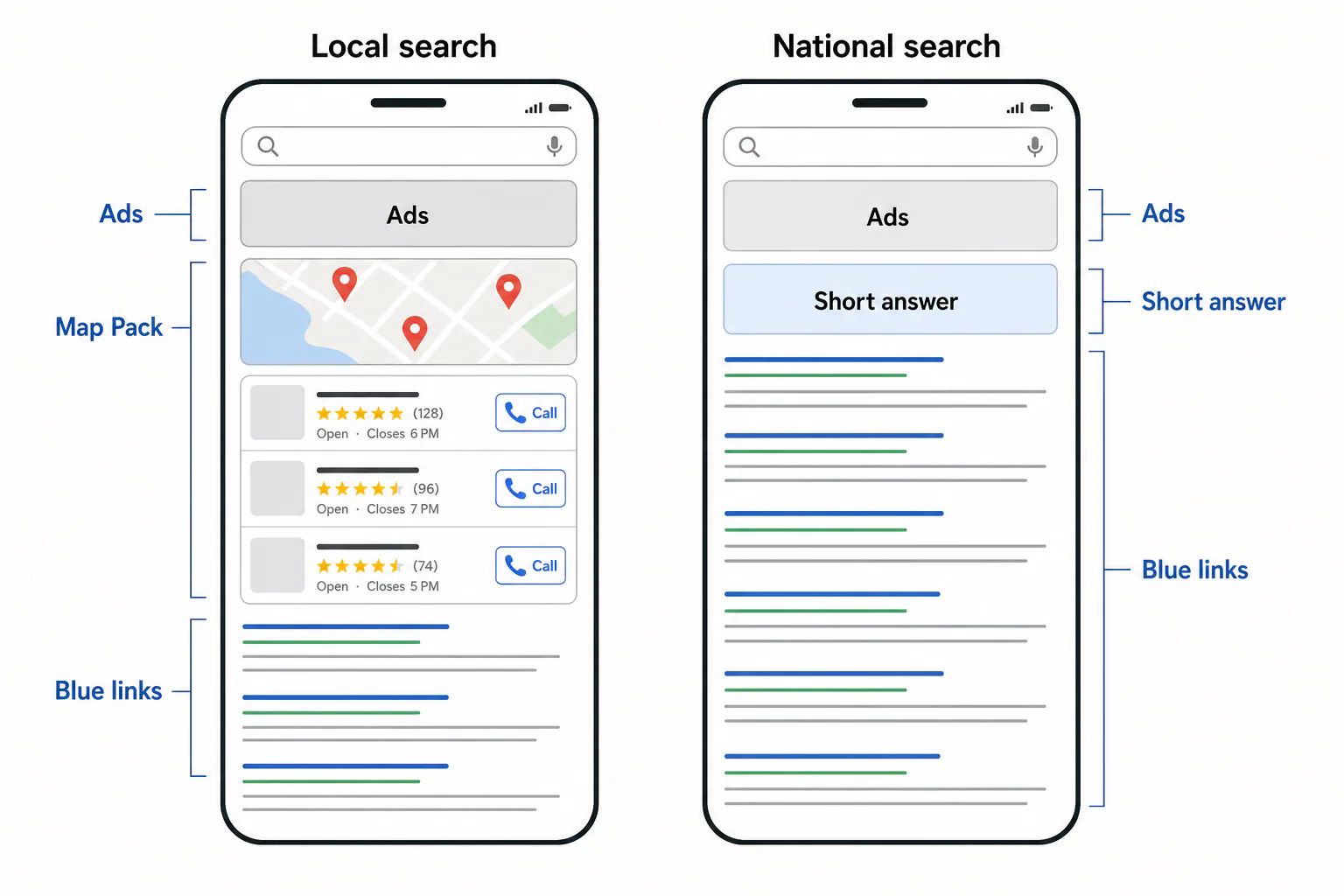
What a local search page looks like next to a national one (Map Pack vs blue links)
Search “emergency plumber” on your phone in Pacific Beach. You usually see a few ads, then a map with three business listings: the Map Pack, also called the local 3-pack. Each shows stars, reviews, hours and a call button. In local search results like these, the map decides your visibility here.
Now search “how to fix a running toilet.” There’s no map, just blue links and maybe a video box. That page is where national search visibility lives, and search engines fill it with the most relevant guides. Google changes these layouts often, but the split holds: nearby searches get a map, and how-to searches get links.
What Local SEO Involves
Local SEO is the work that gets your business into the map results for people nearby, and most of it happens outside your website.
Google Business Profile, reviews and citations
Your Google Business Profile is the center of it all. Pick the right primary category, add hours, services, photos and your service area, and keep a complete, current profile. Add a steady flow of real reviews, with a reply from you on each. Citations are listings of your name, address and phone number (NAP) on directories like Yelp, Apple Maps and the BBB. They need to match, or search engines and customers get confused.
Reviews also tell you how customers talk. If they mention parking, dress code or a specific service, say the same things on your own website pages. That helps search engines confirm those details and links your listing work to your site.
How to show up in the local 3-pack
Google says local rankings come down to three things: relevance, distance and prominence. These steps help you show up in the local 3-pack:
- Choose the most accurate primary category, and add secondary ones only if they’re true.
- List your services using the words customers actually type.
- Show the same NAP on your website as on the listing, and link the listing to a relevant page.
- Ask every happy customer for a review, and answer the good ones and the bad ones.
- Post photos and updates regularly so the listing looks active.
Distance is the one you can’t change. A shop in Mission Valley will rarely make the 3-pack for someone searching in Oceanside, however polished its listing is.
Local marketing in San Diego: neighborhood pages and local content
San Diego isn’t one market. It’s a patchwork of neighborhoods, and people search that way: “dog groomer Clairemont,” “AC repair El Cajon.” Every local business there can win local search by tying each page to a specific location. If you serve several areas, give each a location specific page with something real, like jobs you’ve done there. Pages copied with the city name swapped get ignored. Nextdoor is also where neighbors ask who to hire.
Where local SEO falls short
It leans hard on reviews, so a competitor with years of five-star ratings is tough to pass. If you serve customers at their place and hide your address, you’ll mostly rank around your base, not across your whole service area. It only reaches people nearby. And an online-only store can’t use it at all.
What Organic SEO Involves
Organic SEO is work on your website itself so it ranks in the regular results, and it decides whether anyone finds you beyond the map.
Content, keywords and technical health
It starts with keyword research: finding the exact queries people type, then giving each main topic its own page. An electrician with one “Services” page loses to one with pages for panel upgrades and EV chargers. Technical optimization matters as much: fast loading, phone-friendly pages, no broken links, and every page open to search engines. Good on-page optimization also helps engines match each page to the right queries.
Backlinks and authority
Links from other websites act like votes, and they build your site’s authority and visibility in Google’s eyes. Tools score this as “domain authority,” but that’s a third-party estimate, not a Google metric. A small business earns links from suppliers, the chamber of commerce and partners. Directories add little authority alone. We use white hat methods only.
Where organic SEO is slow and costly
On national keywords you’re up against big brands with years of content and links, and catching up takes steady effort. National SEO results build over months of regular publishing, and visibility comes slowly. A solid SEO strategy and steady optimization keep that effort on track. If all your buyers live a few miles away, organic traffic from people who will never buy from you is wasted.
A Decision Rule: Which One Does Your Business Need?
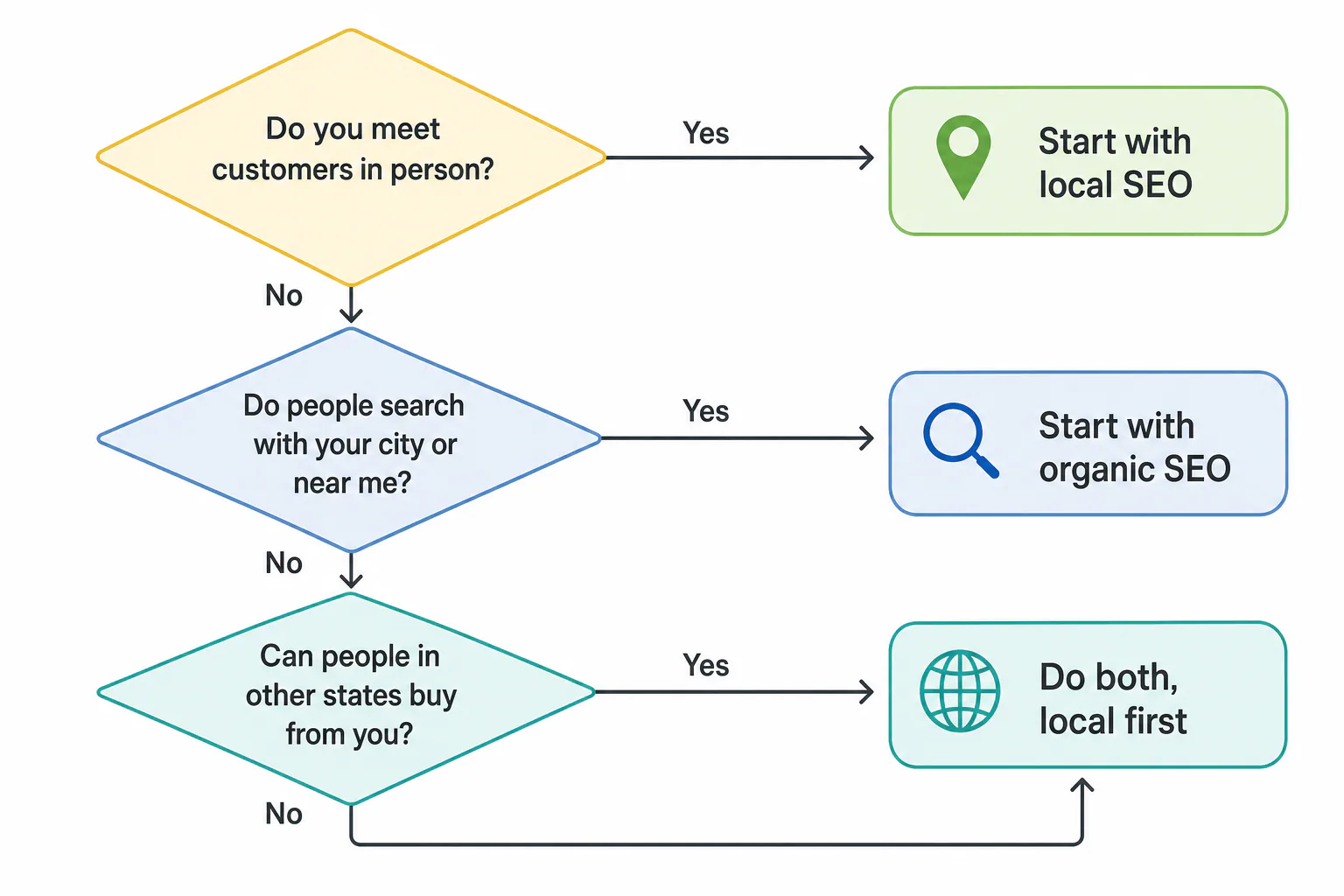
If most of your customers can drive to you, or you drive to them, start with local SEO. If they could be anywhere in the country, start with organic work on your website.
Three yes or no questions to ask about your business
Answer these about your own business:
- Do you meet customers face to face, at your place or theirs? If yes, you can have a Google Business Profile, and map visibility is within reach.
- Do people search for what you do with a city, a neighborhood or “near me”? Type your main service plus your city. If a map shows up, those queries are local.
- Could someone in another state buy from you today? If yes, you need national reach too, because the map won’t show you to them.
“Yes, yes, no” means local first. “No, no, yes” means organic first. Three yeses means both, starting with the map work because it usually pays off sooner.
Which approach fits which business model (storefront, service area, online-only, multi-location)
Here’s the rule applied to four common setups:
| Business model | Example | Start with | Why |
|---|---|---|---|
| Storefront | Café in North Park | Local | Walk-in customers search nearby |
| Service area | Pool cleaner covering Poway to Escondido | Local, plus area pages | Map listing near the base, pages for the rest |
| Online-only | Surf wax brand shipping nationwide | Organic | No listing allowed, buyers are everywhere |
| Multi-location | Dental group with three offices | Local per location, then organic | One listing and one page per office |
Should a local business do local SEO or organic SEO first?
For most, local comes first. Setting up the listing is free, improvements show sooner, and it reaches people ready to call. A local business also gains authority as reviews pile up. “First” doesn’t mean “only,” though. Your listing links to your website, so the site still needs clear service pages. For buyers who research for weeks, helpful content is relevant from day one.
A Worked Example: One San Diego Business, Both Strategies
This example is illustrative, not a client case, but it shows how one business uses both strategies at once.
Starting point and goal
Picture a small bakery in North Park. It sells over the counter and ships cookie gift boxes across the country. The website has a home page and a menu file, the Google listing still shows old hours, and there are only a handful of reviews. The goal: more weekday walk-ins and more shipped orders from outside San Diego.
The local SEO moves and the organic SEO moves
For walk-ins, the work is all about the map:
- Set the category to “Bakery,” fix the hours and holiday hours, add fresh photos.
- Put a small card at the register asking happy customers for a Google review.
- Match the name, address and phone on Yelp, Apple Maps and other directories.
- Add a page about the shop itself, with parking tips for the neighborhood.
Shipped orders are a website job:
- Build a page for each gift box, aimed at searches like “cookie gift box delivery.”
- Write posts answering buyer questions, such as how the cookies stay fresh in transit.
- Shrink oversized photos so pages load fast, and make checkout easy on a phone.
- Ask food bloggers and gift guides to feature the boxes, which builds links.
What to track for each and when to expect movement
On the map side, track calls, direction requests, reviews and the bakery’s position for “bakery near me.” On the website side, track organic traffic to the gift box pages, keyword positions and orders. Listing fixes move first. Content and links build over months, and no one can promise a date.

Doing Both Together on a Small Budget
Local SEO vs organic SEO doesn’t need two big budgets. Do the work in the right order, so each step supports the next.
Here’s why the order works. People first search broadly to research options, and your website content answers them. Later they search “near me” when ready to call or visit, and your listing wins that moment. Each strategy needs the other.
A simple order of work
This sequence gets the cheap, fast wins done before the slow ones:
- Fix the website basics: speed, phone display, clear contact details.
- Claim and fill out your Google listing completely.
- Make your business name, address and phone number match on every directory you’re listed on.
- Start a simple, steady routine for asking customers for reviews.
- Add a page for each main service and each area you serve.
- Publish helpful content on a steady schedule.
- Earn links from partners and local organizations.
Timeline and cost: what each costs and how long it takes (typical ranges, not guarantees)
Cost depends on how competitive your trade and area are, how many locations you cover and what shape your website is in. Our SEO Marketing plan is a monthly fee covering onsite optimization, geomarketing, Google Business setup and maintenance, and directories, so search engines see a consistent business. Our blog writing service is a separate monthly plan. Listing fixes show results sooner. Content aimed at national goals takes longer, and results vary. Before you set a monthly budget, read our guide to what SEO for a small business involves, from typical costs to realistic timelines.
Local SEO and Website Services from Websites San Diego
We design websites and get them SEEN through organic SEO, geomarketing, blog writing and local advertising, all in plain words. Our marketing plans cover onsite work and geomarketing, and our Google Business Listing setup and optimization covers the map side. Our blog writing keeps your site growing. Try hyper-local promotions on Nextdoor or consulting to build your search strategy. We can’t promise rankings, but we can show you the right order.
Frequently Asked Questions
Is SEO organic search?
Is SEO organic search?
SEO is the work you do to earn a place in organic search, the unpaid results. Local SEO is organic too, because no one pays Google for a spot in the Map Pack. The paid version is PPC, where ads from Google Ads sit above or between the free results. When an agency says “organic,” ask whether they mean national rankings or everything unpaid.
Does local SEO work?
Does local SEO work?
It works well for businesses that serve a specific location, because Google shows a map for most nearby searches. How well it works depends on your category, your distance from the searcher, your reviews and how strong the competition is around you. A complete, active listing usually does better than a neglected one, but no one can honestly guarantee a 3-pack spot.
Is local SEO better than organic SEO for a small business?
Is local SEO better than organic SEO for a small business?
Neither is better in general. For a storefront or a service-area business, local work usually comes first, because it reaches people ready to call or walk in. For a business that sells online across the country, broader organic work matters more. Many small businesses need both, starting with the one that matches where their customers are.
Can local SEO and organic SEO be done together?
Can local SEO and organic SEO be done together?
Yes, and they help each other. A fast website with clear service pages supports your map listing, and an active listing with good reviews sends visitors to your site. The trick on a small budget is order: fix the website basics and your listing first, then add content and links over time. One SEO strategy can cover both.
How long does local SEO take to show results?
How long does local SEO take to show results?
There’s no fixed timeline. Once Google verifies a new listing, your business can appear on Google Maps, but ranking well for competitive searches takes longer. Fixes to an existing listing and its citations often show sooner than content work. Busy trades in crowded areas take more time than niche businesses with few rivals nearby.